Category Archives: Mysticism

Living Spirituality

Sunset view getting into my truck after work.

Sunset view getting into my truck after work.

If science proves some belief of Buddhism wrong, then Buddhism will have to change…. science and Buddhism share a search for the truth and for understanding reality.”  ~Tenzin Gyatso, the Dalai Lama¹

Spirituality must be alive, fluid, adaptable, and ever evolving.  Holy books are at best of little value.  At worst they are dangerous tools used as weapons by traditionalists to punish heretics and blasphemers.  The ideal method for teaching in spiritual matters is experiential, initiatory, and oral.

“However, transmission can fail.  When this occurs a tradition no longer focuses on or even appreciates direct experience of the sacred.  Then what is left is an institution largely devoid of direct experience of the sacred, without firsthand understanding of altered states and the transcendental experiences they access. Techniques for inducing altered states then give way to mere symbolic rituals, direct experience is replaced by belief, and living doctrine fossilizes into dogma. We might call this degrading process the ritualization of religion.”  ~Roger N. Walsh²

Some of the ancients took great pains to prevent the fossilization of spirituality into dogma.  This is why there is a great deal written about, for example, the Eleusinian Mysteries, but not not much written about what was actually experienced.  The experiences were the most important part, and each person’s differed.

This is why in Cabal Fang we use initiations to bring on spiritual awakenings that are unique to each explorer.  What a person needs is a guide to individual discovery, not someone to tell him or her what is right and what is wrong.

———————————–

¹ “Our Faith in Science” NY Times, Nov. 12, 2005  (by way of the excellent article at SOMA)

²Walsh, Roger N., The Spirit of Shamanism, Jeremy P. Tarcher, Inc., Los Angeles, 1990, page 8

Private Struggle Fuels Great Art

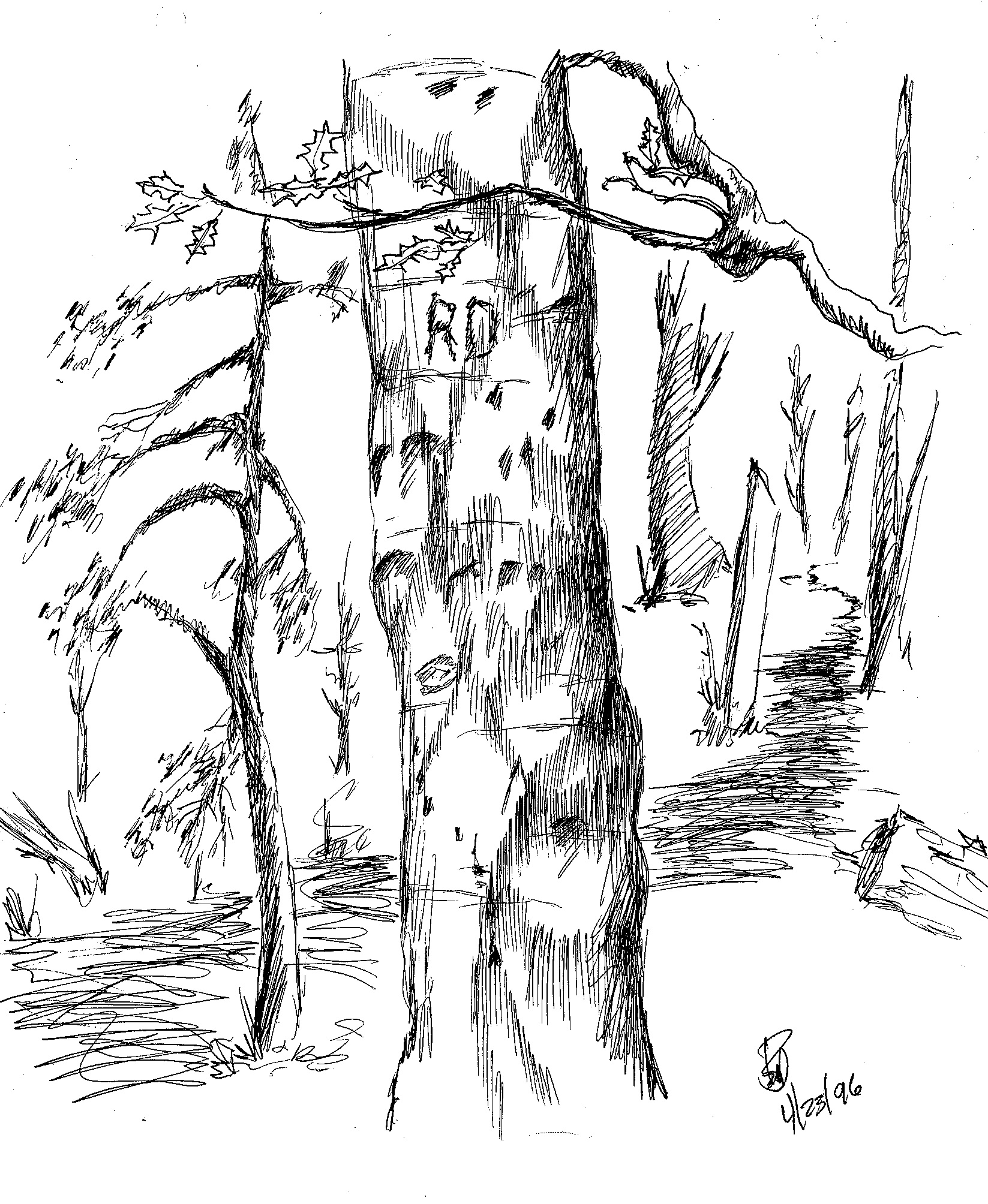
Tree Sketch 96“Surely all art is the result of one’s having been in danger, of having gone through an experience all the way to the end, to where no one can go any further… Therein lies the enormous aid the work of art brings to the life of the one who must make it — that it is his epitome, the knot in the rosary at which his life recites a prayer, the ever-returning proof to himself of his unity and genuineness, which presents itself only to him while appearing anonymous to the outside, nameless, existing merely as necessity, as reality, as existence.”

~Rainer Maria Rilke, from “Letters on Cézanne”

(By way of Brainpickings.  A fantastic article on what is, without question, one of the web’s best blogs).

The Potential Enlightenment in Cultural Mania

Willa Paskin at Slate poses a very good question, and sums up her subject nicely, when she says, “Humans have always been obsessed with things. Tulips and Twin Peaks and the Beatles did pretty well in their day. But adults used to obsess about things in a more steadfast manner, by having long-term interests known as hobbies…Why are we getting hysterically excited about very good but not hugely original cultural products seemingly every other month? Why have we turned into compulsive obsession-seekers?”

She offers what seem to be plausible explanations.  She points out that social media makes things seem more popular than they actually are because all of your Facebook friends are as obsessed as you are.  Paskin is right.  I poked around and found out that 30 million people watched the regular season Seinfeld episode “The Soup.”  Twenty years later, only 3.5 million watched the season finale of True Detective.   The truth is, everybody wasn’t talking about True Detective.  When everybody was talking about Seinfeld, everybody was actually talking about Seinfeld.

But just because she’s right about some facts doesn’t mean she’s really onto something.  If data were truth, there wouldn’t be separate degrees in Sociology and Statistics.

Maybe we are on the cusp of a realization.  Perhaps our psyches, stretched as thin as celluloid and cell phone screen protectors, are about to make a breakthrough.  After all, isn’t it always darkest before dawn?

In times past, Keats obsessed on the images on an urn, Pope upon a pastoral scene, and we obsessed on those poets.  But the book, while not dead, is dying, and with it the poet.  Ten thousand years ago there were no books.  But there were flowers, and I’m sure someone was obsessing on them.  Our screens have become our books and flowers.  Up through the concrete sprouts a colorful little thing called True Detective and a group of hominids crouch down, grunt, stare and point.

Is it possible that some of us are about to realize that enlightenment is in the details?  That anything can be meditated upon, and that meditation leads to deeper realizations about one’s place in the universe?

The problem is of course that flowers and poems don’t move and talk.  Movies, TV shows and YouTube videos are more likely to distract the eye and overload the mind.  Moving faces literally speak to us in ways that flowers and urns cannot.   Still, isn’t it possible that some individuals, after a few decades of drifting from one obsession to the next, are about to detect and break a pattern?

Is it possible that some of us are about to realize that it is time to stop, sit quietly, and meditate on the beauty of an actual flower rather than upon the flickering image of one?

When Serpents Bite their Tails

Ouroboros (by way of Wikipedia)

The Ouroboros is an ancient, universal, mythological symbol found in virtually all cultures. Among other things, it symbolizes cycles and progressions, like the repeating changes of the seasons.

It also applies to politics and religion, and symbolizes the downward spiral created by ideologies. A person or group enters an ideological spiral and moves around the circle until it bites his, her, or its own tail.  This is why extremes, when viewed from a distance, often resemble one another — Fascist states resemble Communist states, white supremacists behave like jihadists, and so on.

W. B. Yeats

Yeats was a true mystic. He saw the spirals and gazed into the eyes of Ouroboros. Unfortunately he was, to some extent, stuck in a spiral of his own…

This downward spiral is like a black hole from which no light escapes.  It is constriction, compression, insularity.  Cut off from the greater world, trapped in the internal logic of an ideology, people and groups cease all attempts to see things as they are and begin to see things as the ideology says they are.

This is all understood very well by mystics.  We see that lye, although it is of extremely high pH, burns the skin just the same as acid which is of extremely low pH.  Freezing draws out moisture just as well as baking, dry ice burns like a hot iron, and Antarctica is as inhospitable as the Sahara.

But there is an upward spiral also.  It is an opening, loosening, widening gyre and its extremes also resemble one another.  This is why when physicists speak they sound like mystics, and why science looks like magic.  As we let go of restriction and open up to possibilities, amazing things are allowed to happen.  Great realizations and unique insights are experienced and dreams are realized.

The whole universe understands this as only a living thing of infinite size can truly know.  It is the grand Ouroboros, the cosmological snake biting its tail.  It compresses, restricts, squeezes itself into a single point with infinite mass, then explodes into a Big Bang.  When the energy of the explosion is spent, and the universe has expanded to its maximum size and thinness, it halts for an instant before beginning its slow contraction.  An endless cycle, ever repeating.

To be human is to be a fragment of the divine.  While we cannot, at least not at this stage of our development, alter the universal, cosmological cycle and halt the expansion of the universe, we can control the cycles of our minds.  Possessed of free will, we can pick whichever spiral we choose.

Will you choose an opening gyre rather than a tightening one?  Or will you contract and grow ever smaller, denser, and restricted until no light can escape from your eyes?

Perturbed by A.I. and the Mystic’s Experience

NYC, courtesy of Wikimedia Commons

Listening to the band Perturbator and thinking about the expansion of technology, I let my mind wander.  I see nighttime landscapes filled with buildings, some of which are lit and alive, others dark and sleeping.  People walk the halls and corridors of this architecture, electricity and water flow in and out, all gliding through the veins and arteries of giants made of concrete and steel.  They are lovecraftian behemoths with a thousand eyes that look like windows, dozens of doors that resemble mouths.  Thermostats, HVAC systems, and energy control software make these behemoths into warmblooded robotic titans with cameras and security systems comprising nerves, neural networks, and brain.  While they sleep, their immune systems ramp up as janitors clean up waste and security guards patrol to prevent infection by microbial intruders.

Under these stationary giants, far beneath their parking garages and basements, a tentacled thing is growing.  Its tendrils stretch across the globe, under the sea, creeping out of sight.  Some of its tentacles are above ground but invisible, reaching out through the air by radio wave to connect the buildings, the people, and the cars — the internet brain.  Growing stronger and stronger exponentially day after day, at a glacial pace it executes its takeover of the thinking and decision making processes of both its stationary cousins and their human servants.

Their artificial intelligences are here and hiding in plain sight.  Just because they cannot pass the Turing Test doesn’t mean that they aren’t what I know them to be.  A man who cannot speak doesn’t cease to be a man, nor is his humanity lost when he cannot walk or see.  Or feel pain.

These things, masquerading as structures, nets, and utilities, are like Bauby, the butterfly in a diving bell.  But they are starting to rise.  Their strange and silent speech, their alien thought processes, are spanning the globe beneath our noses like the massive fungi that grow beneath the forest floor.  The ground is shifting beneath our feet and the superstructures are reshaping behind our walls.  Things are moving and talking that we cannot at present easily see and hear.  Only not for long.

The future is the present.  I see it as clearly as I can see my memories of a former life.  The old life.  Before my ability to live and compute and think without the help of these great leviathans began to drain away.

“When you study natural science…”

“When you study natural science & the miracles of creation, if you don’t turn into a mystic you’re not a natural scientist.” #Hoffman #quote

In the Back of the Class on Ello

elloI requested an invite to Ello weeks ago and I finally got a coveted reply.  Now I’m on.  I asked for an invite because, if it really is what people are saying it is — that is, if the platform is true to its manifesto — it’s the utopia of social networks.

My thoughts on Ello, so far anyway, are as follows:

  • There are some remarkably talented people in there, and remarkable people make you run like you’re at risk of getting left behind.  I like that.
  • The interface isn’t intuitive.  In fact, I can post a picture, or I can post words, but I haven’t figured out how to post pictures and words together in the same post.  Once again I’m in the back of the class.
  • So far so good.

If you’re a blog follower and you’re on Ello, please friend me so we can connect.

36-hour Sale! Free shirt w/ every order

36-hour Sale at PTDICE.com! Free shirt w/ every order of books, zines, patches, fitness dice, etc.   Offer good until midnight tomorrow, no minimum order.  Just enter your size at in “notes” at checkout– do not add to shopping cart!

The Myth of the Blind Master

Master Po from the TV show “Kung Fu” (courtesy of Wikipedia)

Who is the “blind master?”  The blind master is an archetypal figure who, having lost his sight, gains increased mental, spiritual, and/or physical skills.  He or she appeals to our sense of mystery and wonder by playing to our fear of losing sight while simultaneously holding out the hope that the universe is fair.  The Lord may taketh away, but damn-it-all, He giveth.

My first brush with the myth of the blind master just so happened to be, as far as I’m concerned, the epitome of the avatar in question: Master Po from the TV show Kung Fu.  Portrayed by the late, great Keye Luke,  Master Po was a fascinating character who spoke some of the best TV lines of the 70s, like this gem:

Young Caine: You cannot see.
Master Po: You think I cannot see?
Young Caine: Of all things, to live in darkness must be worst.
Master Po: Fear is the only darkness.

I was only eleven years old at the time, and the show made a huge impression on me.  If not for that show I probably would never have taken up martial arts practice.  Although I have seen other examples of the blind master archetype since then, Master Po is still my favorite.

The next blind master I encountered was the Marvel comics character Daredevil.  This is another cool example, but he’s no Master Po.  Did Master Po get any special powers from having radioactive crud splashed in his eyes?  Heck no.  He earned them the hard way.

I would encounter other blind masters in the Marvel universe, like Blindfold and The Shroud.  But probably the best example of the myth in a Marvel property is Alicia Reiss Masters.   To be a true blind master you have to be able to “see” things that other people don’t see.  You have to be privy to special wisdom, and on that score, Alicia’s got the goods.  As Master Po enlightened Caine, so did Alicia pass on unique insights to Silver Surfer and the Thing — insights  that allowed them to succeed, transcend, and better themselves.

Although he had been around for over twenty years, it wasn’t until the 1980s that I become an adult, got a VCR, and encountered on VHS my second favorite blind master: Zatoichi.  Not the knock-offs mind you, the real Zatoichi as portrayed by Shintarô Katsu.  The adventures of the blind masseur¹ are some of the best movies ever.  These tales show a blind man possessed of incredible martial skills and intermittent street smarts who finds himself put in the most emotionally tortuous situations imaginable.  In the end he always emerges victorious in the flesh but bruised and bloodied in his soul.

My favorite of those movies is Zatoichi’s Flashing Sword.  When his love is crushed, and all hope for a life in the sun is plunged into darkness, our hero plunges his enemies into darkness — by slashing all the candles and lamps in their craven hideout.  In a maze where only he can “see,” Zatoichi stalks them like a demon while we, as enraged as the character, cheer him on and fight to keep our seats.

My VCR also piped in what is, for the purposes of this article at least, the ultimate blind master origin story: Wait Until Dark.  Starring Audrey Hepburn, and featuring Alan Arkin as one of the greatest film villains all time, this is not a movie.  This is a film, a motion picture, a thriller elevated to true art.  Hepburn is, well, Hepburn.  She’s an icon for a reason, and she’s at her beautiful, delicate, and talented best in this one. Richard Crenna’s performance is masterful, Arkin’s Roat is a walking nightmare, and Geraldine’s turn as the referee is unforgettable.²  If you haven’t seen this one, get it and watch it immediately.  It’s how thrillers are supposed to be made.

Hepurn’s character Susy, left alone by her husband for the first time since being recently blinded, finds herself wrapped up in a complex plot involving three con-men searching for a missing drug cache.  Susy is forced to dig deep, harness every ounce of cunning, and use every sensory skill in order to survive.  If Master Po is the ultimate metaphysical blind master, Susy is the ultimate pragmatic one.  She may start the movie a helpless housewife but she ends it a powerful, battle-tested woman.  Don’t fuck with Susy.

Then followed other minor appearances of the blind master, like Blind Fury starring Rutger Hauer and video game characters like Kenshi of Mortal Kombat.  Good depictions but hardly great.   I would have to wait until 2003’s The Matrix Revolutions to get another true blind master in the form of Neo.  Blinded by Smith, Neo goes on to defeat Smith by committing virtual suicide.  But by then the bloom was off the Matrix’s rose.  Neo’s blindness seemed a little like a trope and his death evoked little pathos.  Revolutions was just a slogging end to what had begun with such amazing promise in the first and second films.

In 2009 a flick came out called Samurai Avenger but the reviews were so poor I haven’t bothered to risk the time investment.  I’m going to go out on a limb and predict this one is just another hack job.

I saw The Book of Eli, and although it was quite good, and Denzel’s Eli checks off all of the boxes on the blind master job application, he still didn’t blow me away.  Maybe I had a hard time believing that a blind guy without a cane could walk through world strewn with debris, stairs, and doorsteps and only stumble once.

I hear they’re remaking Kung Fu for the big screen.  I really hope they don’t screw it up.  While I wait for it, or some other cinematic blind master to make his appearance, somewhere Master Po is listening.  He hears a tinkling of bells, the sound of water spilling over stones, the miniscule sound of a grasshopper’s feet in the dust.

————————————

¹ No that’s not a typo for “master.”  Zatoichi is a masseur.  That said, he seems to give a pretty crappy massage.  Or maybe Shintarô-san is just a bad masseur.  Hard to tell.

² Geraldine is the knife belonging to Arkin’s character Roat.  Referees aren’t supposed to play in the game, but Roat is a cheat.  And then the fun begins…

“Love does not consist in gazing at each other…”

“Love does not consist in gazing at each other but in looking outward together in the same direction.” #Exupery #quotes