Category Archives: Mysticism

Drink Deep The Wine of Grapes

imageI got a bottle of this wine yesterday, purely because of the name on the bottle.  The winery took its name from the works of Rabelais, as Crowley did.

I hesitate to pull the cork and sip the wine.

Why?  Is this hesitation symbolic, or is merely because I do not want to see this potential poured out, this packet of delight transformed into an empty bottle?  Is there a ritual waiting to be formulated, a sacrament waiting to be performed with with this wine?

Wine is as sacred as one makes it.  I put it up for later.  There will be a time and a place for this cork to be pulled. Perhaps I’ll be invited to a meeting of the Hellfire Club and I’ll need a bottle for a toast, or perhaps some other rite is coming in due time.


Somebody Else Likes Underhill

Apparently R. Michael Gosselin is enjoying Evelyn Underhill’s 1911 masterpiece Mysticism as much as I did.

If you’re a student of mysticism you must read Underhill’s Mysticism.  Claiming to be a student of mysticism without having read Underhill is like claiming to be an economist without having read anything by John Maynard Keynes.

I hope Mr. Gosselin talks about the book some more as promised. I was going to reply to his post, but unfortunately his blog won’t accept reader comments.  Mr. G., if you have a Google alert set up for your name and you get this message, please open up your blog to reader comments so we can chat about it.

Deciphering a Coded 18th Century Initiation

Thanks to @damon_gang for tweeting this Wired article.  Facinating stuff.

Sabotage Times: My Journey Into The Heart Of The Russian Occult

This article is fascinating and informative. Just try to ignore the way the writer uses the words “magic” and “mysticism” interchangeably.  These two things are not the same as I pointed out in a previous post.

Try not to let it annoy you when he clearly believes in the pop culture version of Rasputin. For the record, Rasputin didn’t cast spells or work magic (at least not consciously). As a religious mystic he used prayer and faith healing to keep alive young Alexei, the Tsarevich, when the doctors had no treatment options.  Remember, Rasputin was loyal to the Tsar and his family during a time when the Tsar was very unpopular.  Almost everything written about “the mad monk” was written by people who despised him.

For an positive look at Rasputin I highly recommend Rasputin: The Untold Story by Joseph Fuhrmann.  Great book.

Quick Candle Ritual 101

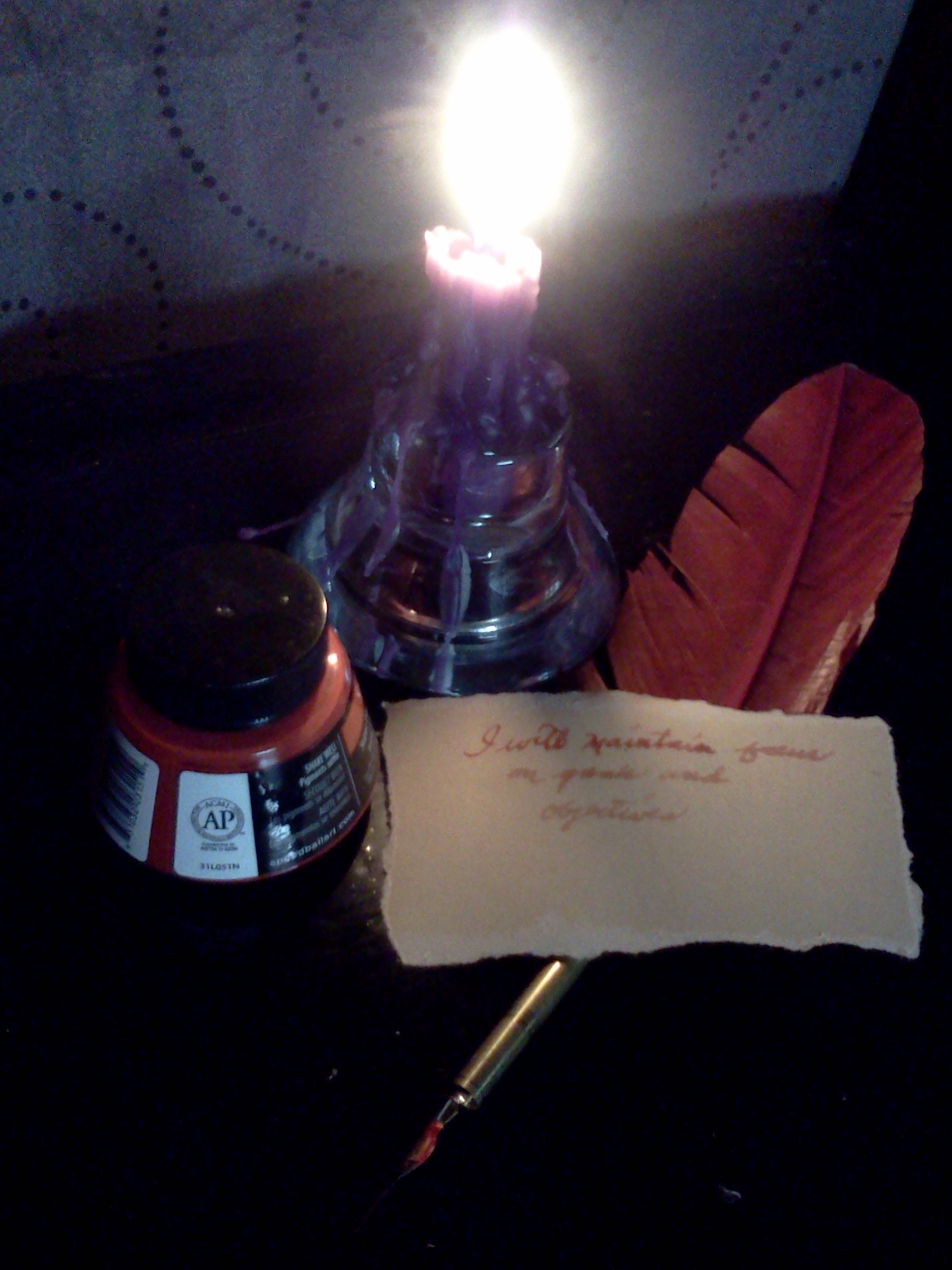
It’s amazing what you can get done with a candle, a scrap of paper, and a little ink.

So it was 7:00 am and I had a busy, stressful day ahead.  I guess most folks would have an extra cup of coffee, make an ironclad To-Do list, and get on with the day.

But I’m not like most folks.  I had the coffee, made the To-Do List to end all To-Do Lists, and then got out a candle, a scrap of paper, and my quill pen.

On the paper I wrote, “I will maintain focus on goals and objectives.”  I then put the paper under the candle and took a seat on my prayer stool facing the candle (prayer stools are the best thing since screen doors — I made my own but you can buy one or improvise.  While traveling I usually flip over the hotel ice bucket and use that.  I’m not kidding).  I then spent ten minutes looking at the candle and imagining that my desire for total focus was being sucked up by the candle and beamed out into the universe along with the candlelight.

I had a great day.  Did the Universe hear my plea?  Or did I just self-hypnotize myself into being totally focused on what I had to get done that day?  Does it really matter as long as it works?

Well, I think it kind of does.

Partly because the Universe doesn’t give a crap if I live or die, fail or succeed, unless I do.  But mainly because a Universe that hears me if I take initiative and approach Her respectfully is a much more pleasant place to live than a dead Universe that cannot hear.

I do this kind of stuff all the time.  Try it — it’s fun and it works.

Jack Parsons: Rocket Scientist and ‘Silly’ Man?

Interesting article on Jack Parsons.  The author thinks Jack was a silly man, and by extension, that occultism is silly.  Although I can see why a skeptic might find Mr. Parsons silly,  I disagreed that Occultism is silly and took issue with the author’s logical fallacy of accident.  Hilarity ensued.

A Glaring Hole

The Gutenberg Bible courtesy of Wikipedia

Perhaps a sin that humbles you is better than a good deed that makes you arrogant.” -Sheikh Hamza Yusuf

This morning I was browsing and came across the above quote.  I then did a web search on Yusuf and found that he is a Muslim scholar.  His quote struck me as very wise indeed, and not in keeping with the popular perception of Islam.  I searched around a bit and found other bits of Muslim wisdom.  I realized that my knowledge of the religion is poor when compared to others.  Clearly I have some reading to do.

And yet, although I don’t know as much about Islam as I should, I have a suspicion that Islam has much in common with most of the world’s mainstream religions.  They all seem to have the same basic issue:

Tradition and belief in a Holy Book doesn’t allow the devoted to jettison outdated material and  abandon ideas that are out of step with the modern world — prohibitions against contraception, beliefs in creationism, oppression and/or hatred of outsiders (women, gays, other races and faiths, etc. etc.) and may others.

In order to avert Collapse (name your poison: Ecological, Environmental, Economic, Political, etc.) humanity will need to turn away from fundamentalism and embrace change and growth.  Holy books must be edited and revised, and all of the vengeance and hate expunged.  Sadly, to my knowledge there is only one quickly-becoming-mainstream religion that believes each individual should create his or her own personal Holy Book, and that no single one is any better or worse than any other.  The sad thing is, I bet most of my readers have no idea which religion that is.

Islam gets lots of bad press, but then all of the mainstream religions do.  Critics of religion always point to distasteful passages that the average believer tries to ignore.  If believers had the courage to evolve and grow, to expand their understanding, to edit out things that just don’t make sense anymore — kind of the way Thomas Jefferson did when he produced his now-famous Bible — imagine the respect they would garner from critics and non-believers.  Imagine the effects on the world we live in.

What if, for example, a powerful religious leader removed Leviticus 20:13 from his official version of the Bible (the passage saying the punishment for homosexuality is death)?  What effect might that have, not only on the leader’s flock, but on the world?

If the object has been to worship books, the mainstream religions have done an excellent job.  But if there is a God or Gods, I suspect He/She/They have entirely something else in mind.

The Forgotten Impact of the Occult

Thanks to Chas Clifton for pointing out this great article by David Metcalf.  Lots of this stuff I already knew, but I wasn’t aware that,

In 1876, when retired Union Army Col. Henry Steel Olcott conducted the first public cremation service in New York City, he was lambasted in the press as a heathen presiding over a “pagan funeral.”

Olcott was an occultist and President of the Theosophical Society.  Nowadays cremations account for a third of all interments.  Who knew?


You’re an Occultist? What’s That?

My business card.

First off, as an occultist I think I’m in pretty good company.

It might surprise you to know that the greatest scientist who ever lived, Sir Isaac Newton, was an occultist.  So were Francis Bacon (who might the real Shakespeare), Sir Walter Raleigh, and Sir Arthur Conan Doyle (author and creator of Sherlock Holmes), as well as poet and Nobel laureate William Butler Yeats.  Popular NPR reporter and author Margot Adler, filmmaker David Lynch, and author Alan Moore (Watchmen, V for Vendetta, and League of Extraordinary Gentlemen) are all occultists as well.

As to the question “what’s an occultist?” an occultist is someone who studies the occult.  What’s the occult? I prefer André Nataf’s definition from his Dictionary of the Occult (Wordsworth Editions, (1994), page 80):

“Occultism holds that humanity is only revealed to itself by transcendence…religious feeling is a necessary part of humanity, with the important provision that this religious feeling is the ‘raw material’ on which the initiate works in order to experience glimpses of the sacred, borne within him and all mankind.  This transmutation of the religious into the sacred is the very object of the occult sciences and, especially of initiation.

Of course, literally speaking, the occult is simply hidden knowledge.  According to the 1913 Webster’s Dictionary:

Occult [L. occultus, p.p. of occulere to cover up] Hidden from the eye or the understanding; inviable; secret; concealed; unknown.

Occultists and occultism have gotten a lot of bad press.  But then, so have football coaches, priests, and clowns.  But we don’t let these outliers give football, religion, and carnivals a bad name, now do we?

Here are a couple of links to articles about “occultism” that you may find helpful:

Definition of “Occultism” from the religioustolerance.org website

Definition of “Occult” from Wikipedia