Category Archives: Writing

My Story in Quail Bell Magazine

I’m proud to announce that my short story “Iron Paul” was accepted by Quail Bell Magazine.  You can read it here.

“Iron Paul” is the story of an aging lathe operator in a baseball bat factory.  Paul is struggling to adjust to changing times and attempting to determine which of  his company’s time-honored traditions are valuable and which are not.

Quail Bell Magazine is “a social and artistic experiment in the imaginary, the nostalgic, and the otherworldly.” Although this woman-run shop is centered in the Washington, D.C.-Maryland-Virginia area, they publish content from all over the world. Their publication and website will not only challenge and inform you with content of all kinds — journalism, art, literature, photography — but it will also entertain and amuse.  So, basically, reading Quail Bell Magazine is sort of like getting your feet tickled by the giggling toddler love child of Edgar Allen Poe and Emmeline Pankhurst.  Not really.  I don’t know what I’m saying.  It’s just cool, and fresh, and original, and sincere.

So go check them out.  And while you’re there, check out my story too.


Keep Cup

imageThis is my new KeepCup.  I’ve had it for a week (which amounts to roughly thirty cups of coffee¹) and I already love it.  Since the cup ecologically “pays for itself” in just fifteen uses, it has already paid for itself twice.  You can get one here.

They are fully customizable, part by part.  So if you don’t want a brown and black one like mine, you can choose from about twenty different colors for the cup, band, lid, and plug to create your own masterpiece.

It’s a durable (tested to 1,500 uses!), non-insulated, spill-resistant cup that can be used for any kind of beverage.  Durability is important to me because, let’s face it, I’m a hardcore java junkie who really puts the wear and tear on his equipment.  My Aladdin cup broke and had to be fixed, and my Tervis had to be retired because hard water stains accumulated on the inner rim until it looked like the shore of the Dead Sea (sorry Tervis, but I don’t care what you say, your cups are for clear liquids only).

KeepCups are sustainably manufactured in Australia and shipped from distribution hubs in AU, UK and the US.

———————————————————-

¹ Look, I’m a writer.  I drink a lot of coffee.  Before work I have four cups in a ceramic mug at the house, and then I start using the KeepCup on the road and at the office, where I knock back another five or so cups.  I try to limit my consumption to a pot a day, because, you know, that would just be excessive.  Better than swilling bourbon all day, right?

How to Service a Generator

image

This is a generator. They have to be periodically serviced, which is kind of a pain in the ass.

Although I consider myself a mystic (more on that here) and it may seem counter-intuitive, I’m also a practical, do-it-yourselfer, kind of like Robert Pirsig.  I do as much of my own home repairs and maintenance as I’m able.  Like keeping my generator ready for emergencies.

With all the cold weather and the snow up north, this past weekend I figured it would be a good idea to get the old girl ready — just in case.

Generators that run on regular gas require frequent oil changes.  Some models recommend changing the oil as often as every 8 operating hours.  That’s what my owner’s manual says.  But after 8 hours the oil is usually still amber, so as a rule I just change mine after every 24 hours of running time, or whenever the oil gets dark.  When I went to service mine today, the oil was dark so I drained and refilled.

image

See that hole? That’s where the oil comes out.

Get yourself a drip pan, a small funnel, and some bricks.  Prop the generator up, a little higher on the side away from the drain plug, and put the pan beneath the hole.  Remove the plug and let it drain until the drips stop.  Make sure your pan has some kind of screen to prevent a dropped drain nut from falling into the used oil reservoir.  You don’t not want to have fish around in there like a kid looking for a bar of soap in the bath water.

When drained, replace the plug.  Be very careful that the nut is properly threaded before you tighten.  If the nut is cross-threaded and you strip the threads on the header, you will turn your generator into a very greasy and expensive paperweight.  Add oil to the fill line on the dipstick (that’s what the funnel is for).  Run the motor for a few minutes, check again, and add more if needed.

wpid-IMG_20140105_150816.jpgIf it has been awhile since the generator has been operated it might not want to start.  If that’s the case, there’s a good chance that you have gummy gas in the carburetor.  Remedy that by loosening the carburetor bolt just enough to let the bad gas run out.  Stick in the nozzle of some carb cleaner and shoot in plenty of that stuff.  Be careful and do not remove the bolt all the way.  If the carb comes apart, putting it together will be harder than solving a Rubik’s Cube.  Re-seat the bolt.  I advise putting something beneath the carb when you do this so that you catch the gas and carb cleaner that runs out — you don’t want all of that going into the environment.

image

That bolt right there in the middle of the photo will drop the carburetor cover. Be careful during loosening. If the carb falls apart, you need a PhD to put it back together again. I’m not kidding.

If it still won’t start, make sure that (1)  the running switch in the “on” position (2) there’s gas in the tank (3) the choke is all the way on and (4) the spark plug wire is attached.  Try again.  Still won’t start?  Remove the spark plug, clean it, and shoot a short blast of carb cleaner in the hole.  Replace the plug carefully, attach the spark plug wire, and try again.  If you still get no love, you’re gonna need a pro.

In the picture on the left, just behind the carburetor (the round thing with the hex bolt in the middle), you should see a silver oval thingy with a black cover.  That’s the air filter.  You should replace that once in a while.  It can get pretty crappy and obstruct air flow.

Before you put your generator away for an extended period of time, condition the gas with some Stabil gas stabilizer.  This will prevent moisture buildup in the fuel and help ensure easy starts.  Follow package instructions.

Most importantly of all, get your generator out once a month and let it run an hour or so.  Engines are made to run.  They like it.  It makes them happy.  If you keep them happy with regular operation and service, they will make you happy.

Warning:  Be careful around motors and gas.  Sparks can ignite spilled fuel.  Keep gas containers capped and ten feet away from clanking tools.  Safety first!

Sunday is as Good a Day as any to Save a Few Hundred Thousand Lives

image

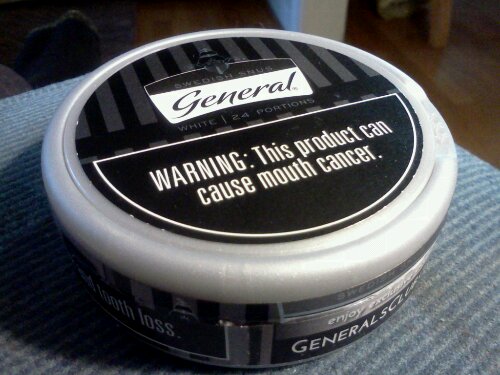
This is can of Swedish Snus by General, a division of Swedish Match (aka Svenska Tändsticks AB). You put it in your mouth so you can get nicotine without inhaling toxic vapors.

What day is it? Sunday? Seems like as good a day as any to save a few hundred thousand lives.

According to the Centers for Disease Control and Prevention (CDC), smoking causes over 400,000 deaths each year in the United States.¹  The CDC doesn’t have any statistics on smokeless tobacco deaths because the risks are too small to reliably track.

Yes, there are some reports from the WHO on the risks of smokeless tobacco in general — if you include all of the various kinds used worldwide — ones prepared with corn starch and lime and creepy additives.  But as for Swedish snus, even the WHO has to admit, “two studies from Sweden that were well-designed and controlled for smoking showed no association between smokeless tobacco use overall, specifically ever use of snus, and oral cancer.”

As Ken Warner (director of the University of Michigan Tobacco Research Network) said,

“The Swedish government has studied this stuff to death, and to date, there is no compelling evidence that it has any adverse health consequences. …Whatever they eventually find out, it is dramatically less dangerous than smoking.”²

Basically, what it comes down to is.  If you are smoker, go to your local tobacco shop and get some snus.  Put it in your mouth and stop smoking.  It may save your life.  If every smoker in the U.S. did this it would save hundreds of thousands of lives.

Don’t believe me?  There’s a nice guy named Brad Rodu who runs a blog called Tobacco Truth, and he has a ton of information on his blog.  Brad is a professor of medicine at the University of Louisville.  He holds an endowed chair in tobacco harm reduction research, and is a member of the James Graham Brown Cancer Center at U of L.  If you ask him questions on his blog, like I did, he’ll answer them.

Snus cans have government mandated warning labels that are not supported by facts.  How stupid is that?

Snus cans have government mandated warning labels that are not supported by facts. How stupid is that?

Still don’t believe me?  Read this report by the Department of Public Health and General Practice at the Christchurch School of Medicine and Health Sciences in Christchurch, New Zealand.  According to the report, snus does not appear to lead to increased risk of cancer, cardiovascular disease, inflammatory bowel disease, or diabetes.

But you say, “Mitch, why do snus cans have those scary warning labels?”  Answer: Because there’s a law passed by our beloved Congress that says that all tobacco products have to have warning labels.  And, as we know, our Congress is full of people who are not swayed by facts.  Half of them are scientifically illiterate.  There are quite a few who don’t even believe in evolution.

It comes down to this.  If you aren’t addicted to nicotine, don’t start.  Clearly it’s better to avoid putting tobacco into your body altogether if you can.  But if you’re an addict and you can’t quit, choose smokeless products.  The risks are clearly less.

—————————————————————

¹ According to this CDC Fact Sheet.  They have smokeless tobacco fact sheet, but it’s uncontaminated by any hard statistics.

² Courtesy of this Wikipedia article.

2013 in review

The WordPress.com stats helper monkeys prepared a 2013 annual report for this blog.

Here’s an excerpt:

A San Francisco cable car holds 60 people. This blog was viewed about 3,400 times in 2013. If it were a cable car, it would take about 57 trips to carry that many people.

Click here to see the complete report.

Book Review: The Search for Abraxas

This is what was inside the envelope.

The Search for Abraxas

I went after this book like a duck after a June bug, mainly because I have been involved in my own search for Abraxas for several months and I wanted to experience alternative perspectives.

The first praise I want to shower on the book is that the writing is solid and intelligent, and the volume is well edited.  There are no run-on sentences, no typos, and although there is some speculation on the part of the authors, there are none of the lunatic ramblings one often finds in occult books.

The volume is in three sections.  Section I contains an excellent overview of Gnosticism and Qabalah.  For those knowledgeable about neither, this alone is worth the price of admission.  Abraxas, the transcendent Gnostic deity who is good and evil in both extremes, is supposed to be the thread that sews the three sections together.

But in Section II, which delves into the work of Austin Osman Spare, witchcraft, and Meso-American mythology, the authors get into the weeds.  The thread is lost and the promise of Section I begins to dissipate.  Although interesting, this section almost seems to belong in another book.

On the other hand, I must say that the color plates (paintings, drawings, etc.) are outstanding, and feature the works of Austin Osman Spare, Harry Clarke, Hans Voight, Edmund Dulac, Wolfgang Paalan, Max Ernst (“The Robing of the Bride” gives me chill bumps), and Drury himself.  These are A+.

Sections III and IV, the final more than the former, get the caravan more or less back on the road.  To quote the conclusion,

“There is an animal in man, and there is a God in man.  in order to produce a harmonized microcosm these aspects of our nature have to be firstly acknowledged: it is then that the self may be transformed.  Perhaps the God which best symbolizes this mystical venture is the one who is both man and a hawk; He who is of the Sun and whose legs are coiling serpents, symbol of Wisdom reaching down to Earth.  He who holds the sacred shield…and whose name is Abraxas.”

Nevill Drury sums it up in his introduction to the Second Edition: “As co-authors of this reissued work Stephen and I both hope that new readers will find much that is worthwhile in the pages that follow, despite the fact that in several of its key themes The Search for Abraxas has been overtaken by more recent scholarship and research.”

I wasn’t at all disappointed, but neither was I blown away until I contemplated the fact that was written over forty years ago.  It is a remarkable book, a ground-breaking book, and for that reason alone it is recommended.  It was ahead of its time.


No More Free Rides

Starting today and going forward, the only way you can get one of my books free is to pirate it or go to a library.  But it’s not about greed.  It’s about commitment.

I didn’t charge for my first few books because I wasn’t confident in their quality.  Putting them up for free made it easy for me.  If people didn’t like it, I could say to myself, “Well, at least they didn’t get ripped off.”

The problem is that if a book stinks, the reader is still ripped off even if the book is free.  If a person sees your book cover, becomes intrigued, gets hyped with anticipation, downloads the thing, and invests the reading time, he or she has been ripped off by an inferior product even if it was free.

Putting some of my books up for no charge wasn’t giving the reader a free ride — it was giving myself a free ride.  If I charge for my books it’s a message to myself that says, “Mitchell, you owe the public a superior product, one that’s worth the reader’s investment of time and money.”

I took a step back and realized that my stuff is good — really good — and that I should stand behind it unequivocally.  And from now on I am.

As they used to say back in the ’70s, “Ass, cash, or grass — nobody rides for free.”  Especially me.

—————————————–

Here are links to my eBooks at Smashwords — but if you prefer other websites, they are also available at Amazon, Barnes & Noble, Kobo, or Diesel.

Wisdom of Raven CoverWisdom of the Raven: The Mystic Way of Cabal Fang

By Robert Mitchell, Jr
Series: The Cabal Fang Martial Arts Study Course, Book 2. Price: $1.99 USD. Words: 6,560. Language: English. Published: January 16, 2013. Category: Nonfiction
A blend of fact and fable, the practical and the esoteric, ‘Wisdom of the Raven’ instructs the reader in the spiritual underpinnings of Cabal Fang Martial Arts. Learn the basics of the Three Sisters — contemplation, meditation, and prayer — and how they come together to inform the mystic experience.

Cabal Fang MAM CoverThe Cabal Fang Martial Arts Manual

By Robert Mitchell, Jr
Series: The Cabal Fang Martial Arts Study Course, Book 1. Price: $1.99 USD. Words: 22,860. Language: English. Published: January 16, 2013. Category: Nonfiction
A seamless blend of the ancient and the modern, the physical and the internal, Cabal Fang has one foot apiece in the middle ages and the new millennium. Get a glimpse of what is at once a modern self defense method, a strenuous fitness regimen, and a spiritual framework drawing upon the Western esoteric tradition. For all fitness and experience levels — but not the faint of heart.

Ghilan_thumbGhilan

By Robert Mitchell, Jr
Series: The Montenegro Cycle, Book 2. Price: $2.99 USD. Words: 71,680. Language: English. Published: October 3, 2012. Category: Fiction
Ergie is a high-school slacker with too few friends, so when he meets Zack he welcomes the friendship. But he soon discovers that Zack isn’t what he seems, his parents have a hidden past, and everyone he loves is threatened by a race of ancient creatures known as ghilan. Can Ergie find the truth, and if he does, will he have the courage to do what he knows is right?

Chatters_thumbChatters on the Tide

By Robert Mitchell, Jr
Series: The Montenegro Cycle, Book 1. Price: $1.99 USD. Words: 55,780. Language: English. Published: October 3, 2012. Category: Fiction
Harold has lost his job, divorce is on the horizon, a religious cult believes he’s a prophet, and he’s being stalked by an eerie motorcycle club and its mute, wild-haired mascot named Gator. His skeptical wife Bonnie is fighting to free him from the strange world into which he has fallen while Harold struggles with bizarre and unusual revelations. Is he really a prophet with miraculous powers?

Colin Wilson (26 June 1931 – 5 December 2013)

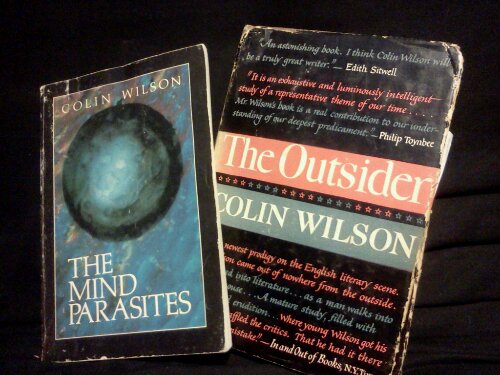
wpid-IMG_20131215_100059.jpgI wrote a memorial to Colin Wilson over at Writer’s Lunch.   If you’re not familiar with the man, please go give it a read.  You’ll be glad you did.


Dan’s ’61 Chrysler Imperial

Dan lives in the same retirement community as my mother.  Whenever I see him I strike up a conversation.  He’s a talker and a character, and so am I.  I can’t remember exactly how we got acquainted, but I think it might have been on a long elevator ride.  Neither of us is the kind of fellow who lets a hundred seconds pass without filling up the gap with conversation.

It was months before I found out that Dan was the owner of the ’61 Chrysler Imperial I had been admiring in the parking lot out front.  One sunny Fall day I had seen him emerge from behind the wheel of the car, but by the time I had parked and gotten inside, he had been long gone.

Finally, just the other night, I bumped into Dan on the way out of the place.  He’s a tall man with short hair grey hair, the bent nose and weathered face of a boxer, and a hint of Jimmy Stewart in his voice.

“Hey Dan!  How’ve you been?  Nice Thanksgiving?”

“Fine, fine.  And you?”

“Never better,” I said.

“Where’s your coffee?” he asked.  He had noticed long ago that I almost always have a cup of coffee in my hand, and he liked to tease me about it.

“Fresh out.  On the way home I was thinking of stopping by Stir Crazy Cafe over on MacArthur Avenue.”

“On the way is it?” he asked.

“I can make it be,” I said.  “So that’s your Imperial out there?  Sure is a beauty.”

“You like that do you?” he said.  “Everybody stares at it and makes comments.  It’s so big it’s silly.”

“But it’s a work of art.  All cars look alike these days,” I said.

“That’s right.  Cars today fall into two categories: door stops and suppositories.”

“Why is that, you think?”

“People don’t want to be individuals anymore,” he said.  “They all want to fit in and be like everybody else.  Nobody wants to stand out.”

“You might be right about that,” I said.

“Did you check out the steering wheel?”

“No, I didn’t.  What’s special about it?”

“It’s square,” he said.  “Go look in the window, you’ll see.  They didn’t have tilt wheels in those days.  So they squared the wheel so that you can slide in easier.  And it has a push button transmission too.”

“You’re kidding!” I said.

“Nope.  I got the old steering wheel in the trunk.  Had to replace it.  It’s in bad shape, just junk.  You want it?”

“No, thanks,” I said.

“Can’t imagine why not,” he said, deadpan.

“You know I was born in ’61, the same year as your car.”

“And I thought you weren’t playing with a full deck,” he said.  “I guess I was wrong.”

“What was that?”

“A full deck?  You’re fifty-two.  Fifty-two cards in a deck?”

I laughed.  “Ah, I get it,” I said.  He had at least twenty years on me but his wit had a keener edge.  I should’ve said ‘Dan, you’re a real card’ but I didn’t think of that quip until the ride home.

“You like cars?” he asked.

“Not especially.  I just like art, and I love it when art and function overlap.”

“I’m a car guy,” he said.  “You know, a buddy of mine had that car.  He was moving and he had to get rid of it, so I took it off his hands.  This is the last year with the fins.  In ’62 they took ’em off.  I often thought I’d like to have one of each model — the two-door coupe, the convertible, and this one, a whole set.  Never got around to it.”

We talked a bit more and then parted company.  Dan went to the wall of mailboxes to get his mail while I went outside.  By the fading light I peered into the window of his Imperial.  The car was immaculate inside.  And there, in front of the wide majestic metal dash, was a beautiful square steering wheel.  It was rounded at the corners, a graceful sculpture with a perfect chrome bar at the bottom used to sound the horn.  I tried to take a picture but the glare of the window wouldn’t allow it.  It seemed to me that the horn would not have honked but rather sounded, like the trumpet of Gabriel on the day of judgment or Heimdall’s horn at Ragnarok.  Every part of the vehicle appeared to have been made my artisans, by Michaelangelos and Leonardos.

I got in my truck and headed off to the coffee shop.  Dan and his Imperial stuck with me.  Maybe next time I’ll ask Dan to drive us to the coffee shop.

My treat.

1961 Imperial Review from Car Review Magazine, April 1961 (courtesy of imperialclub.com)

A Trio of Eerie and Ironic Car Crashes

It all started with the untimely death of Dr. William Coperthwaite, artisan, poet, educator, and author of A Handmade Life, in a single-car accident in Maine.  A modern-day Thoreau, Bill lived an existence infused with simplicity, art and peace.  He had no phone, no computer, and no email.  He steadfastly refused to put a motor on his skiff, paddling it instead with a cedar oar he carved himself.  Yet he was the man who started the yurt revolution,  a living legend in simple living whose name came up at every primitive skills meeting I ever attended.

His death behind the wheel on icy roads is the very definition of cruel irony.  The technology he eschewed resulted in his demise.  Hearing of his death and the manner of it chilled me as fully as if I had been standing by the snowy roadside where he perished.

Then came the story that exploded in the twitter-verse Thanksgiving night when Josh Romney pulled four passengers from a car and tweeted a photo of himself grinning at the scene.  Kudos to Josh for pulling four people from the wreck.  But his expression, pose and tone would have been more appropriate if he had been announcing that he caught a record breaking fish or proclaiming that his sow took first place at the county fair.

https://twitter.com/joshromney/status/406438564289736707

In the context of a narrowly averted tragedy however, his demeanor is creepy and surreal. Maybe it’s the untouched red-eye that glares out of those eyes, but my bones were once again plunged into a deep freeze.

And then last night, the third and final car accident: the death of Paul Walker, star of the car-centric Fast and Furious film franchise, in a single-car accident in Santa Clarita.  A father, outdoorsman, surfer, and BJJ Brown Belt, Walker was well-liked by his co-stars (and by my wife and daughter who have watched every one of his adrenaline-jacked films a dozen times).  Last night my daughter heard the news on Twitter and called out “Mom!  Paul Walker died in a car crash!”  and a pall came over the room.  He and friend Roger Rodas were killed after leaving a charity event benefiting the victims of Typhoon Haiyan.  In true Shakespearean fashion, the instrument of his greatest film success was also the instrument of his demise.

Bad things come in threes, and I have errands to run today.  Is there a cruel irony in store for me after I put the truck in gear and pull away from the curb?  Will there be a headline about a father of four, a local writer and martial arts expert, perishing in a pointless wreck?  Unlikely but distinctly possible.  After all, car crashes don’t come in threes, they come in hundreds and thousands.  Car accidents claim over 100 lives every day in the United States.

Yet we all keep getting into them thinking that everything is going to be just fine. Truth is indeed stranger than fiction.