Category Archives: Writing

Foiled by the Marathon Again

I wrote this the day after the event and I forgot to hit ‘Publish.’  Here it is, a month late.

—————————————-

Yesterday my mother was discharged from the hospital.  Her next stop was going to be a therapy center in Mechanicsville.  Before going to the hospital to transport her, I rushed off to her apartment to get the clothes and essentials she would need for her stay.  It was 10:00 am.

Enter the 2012 Anthem Richmond Marathon.  This year’s half-marathon route ran right up the road her apartment sits on.  Her street was closed to all traffic and there is only one way to get in.

Flashback to 2011: The day of the 2011 Richmond Marathon my mother and I had an appointment to tour the apartment complex she subsequently moved into.  After trying to get in for over an hour, and being turned away three times by police officers and organizers who would not even speak to us other than to say, “Sir, you must move along!” we had to call the complex, reschedule for another day, and go home.

Back to 2012:  For half an hour I drove around in circles trying to get onto her road.  All side-streets feeding into it were blocked by cones and barricades.  Finally, in stress and frustration, I started moving and skirting barricades.  I turned tentatively onto Hermitage Rd. and headed toward her street.  I did not see a single runner or vehicle as I proceeded to my intersection.  I was immediately approached by a male police officer and a female race organizer.  I lowered my window.

“How did you get onto this road?” the organizer said.

“I moved a bunch of barricades.  I have to get to my mother’s place.”

“So you just disregarded the safety of the runners?!  You can’t…”

“There’s was nobody standing at the barricades for me to ask permission from.  Look, I’m going to her apartment,” I said angrily.  “My mother is going to rehab and I need to get her things.  She’s waiting for me at the hospital right now, so…”

“You need to calm down,” the officer said.

“Last year when this happened I turned around and went home.  Not this time.”

“You need to calm down,” he repeated menacingly.

“I’ll be a lot calmer when I get to her apartment.”

The organizer said something and I said something back.  The cop moved closer.  Other things were said on all sides that I can’t remember.

“Look, I apologize for being a jerk,” I said, “but last year you people wouldn’t even talk to me when I stopped at barricades.  This time I just decided I wasn’t going to take ‘no’ for an answer.  But I could’ve been nicer about it.  I’m sorry for being so tense and rude.  Really, I’m sorry.”

I think the organizer said something about watching out for runners before she stomped away.  The policeman waived me to turn and I did.

At the gate to the complex, the security guard stopped me.

“How did you get down here?” she asked.  I told her my story in brief.

“I had to park eight blocks over and walk in with my lunch and all my stuff,” she said.  “What a pain!  You’re only the third person to make it in all day.  The other two said the people at the barricades are really being assholes.”

“In my case, there was little bit of that on both sides,” I said.
A Werewolf Mystery

The basement of her parent’s house was quiet and nobody ever disturbed us there.  There were candles stuck in Chianti bottles caked in layered wax, pickle jars of upturned paint brushes, the smell of raw clay and drying canvases, gesso and pine wood walls and her father’s pipe tobacco.  She was a sculptor, her mother an art teacher, her father an executive.

Our relationship started when I was about sixteen, and getting to that basement was a great reason to take Driver’s Ed.  Our relationship lasted for most of high-school, on and off.  She went away to college white I stayed in, and that was the beginning of the end.  We wrote letters and talked on the phone once in a while, even saw each other as friends a few times after we each married other people and had kids.  But eventually the friendship fizzled.

On cold nights we’d build a fire in the basement fireplace, sit beside it on the brown and orange carpet, talk and neck.  There was always dried medium of one kind or another around the nails of her slender fingers or smudged on her jeans.  She smelled like hay and horses, musk and rose petals.  She was older than me, more mature, a better artist and far more intelligent.  To this day I have no idea what she saw in me.

On a summer night in the late seventies, after a long evening in the basement, we ventured upstairs for a snack.  It was almost midnight.  We stood in the kitchen and ate homemade yogurt with fresh blueberries on top.  A typical snack at my house was potato chips and grape soda.  Under the circumstances, homemade yogurt was mystically nourishing, a spiritual meal.

Eventually it was time to go.  In the back of the house there as a picture window facing the rear yard, and beneath it a daybed where the cat slept.  We stood in front of the window and kissed goodbye.  Her mother came in just as we broke apart.  I complimented the yogurt and thanked her for her hospitality.

In the direction of the window I sensed movement.

I turned and looked out into the yard.  The moon was nearly full in the distance.  The scene was clear, bright and rendered in silhouette.  At about forty yard’s distance there was a wood pile on the left and a piece of farm equipment on the right.  Between them was a twenty-yard expanse of neatly cut grass.  Walking slowly from behind the woodpile, from left to right, was a large dog or wolf.  In the center of the open space the thing stood up on hind legs and continued walking.  It never broke stride.  In the shape of man with a dog-like head, it then moved behind the tractor and was gone.

My girlfriend and her mother had turned to follow my eyes.  They saw it too.  We stood there talking, pointing and staring out of the window.  I’m allergic to cats but I didn’t care.  We sat on the cat’s day-bed for half an hour and waited to see if it would reappear.  It never did.

Eventually I had to go.  They turned on the flood lights and I made it nervously to my father’s old station wagon in one piece.  I climbed in and locked the doors.  When I was a mile away I opened the window and listened to the crickets and cicadas buzzing in the ditches by the road.  Watching the country turn into suburbs under headlights, I drove home in a strange mood.

Thirty years later I would stand in that basement with her sister and help dispose of her adolescent things.  That was long after her mother had died and her father had moved away; after her divorce; after she had died in a car accident along with her two daughters. The fact that she had left her entire estate to an environmental charity, and that her name would live on as a memorial fund, was little comfort.

I’ve been unable to make sense of what I saw that night.  Neither have I been able to understand the sudden and senseless death of my high school girlfriend and her two daughters.  In my head there is only a desolate array of strange and disjointed thoughts, feelings, and memories.  Everything associated with her is like the thing that walked across the grass over thirty years ago — moonlit, liminal, and unexplained.

Book Review: “How Non-Violence Protects the State” by Peter Gelderloos

As a martial artist and advocate of self-defense, violence and non-violence are subjects of great interest to me.  So when I was gifted a copy of “How Non-Violence Protects the State” I devoured it in two sittings.

What I liked:

The gyst of Gelderloos’ argument is that pacifism doesn’t create real change and that the iconic examples of passive resistance are either fantasies, fabrications, or distortions.  In an interesting and convincing way, he provides a thought-provoking counterpoint to the pacifist’s view.  I’m not an expert on the history of struggle, so I can’t promise you that Gelderloos’ history is any more accurate than the popular one but it sounds earnest.  Factual or not, it’s good for us to criticize our idols — even MLK, JFK, and Gandhi.  I’m a believer in the axiom that we are each our own heroes, and this book’s gears mesh okay with that.  It’s a hole-punching good time for anyone who enjoys a good paradigm roast.

What I didn’t like:

Although Gelderloos says activists must embrace all tactics in the struggle for change, I got the distinct impression that he thinks pacifists are pie-in-the-sky ninnies who don’t have the stones to do wet work.  I can’t help imagining that behind the page lurks a slightly less twisted version of  G. Gordon Liddy in a t-shirt with a giant “A” on it.  I hope I’m wrong.

My personal view on the subject of resistance:

Patriarchy goes back to the development of agriculture, when humans started slapping around Mother Nature.  We gave up hunting and gathering, raped Her with a plow, and started taking our food by force.    From this original abuse grew the patriarchal division of labor, patriarchal religions, governments, laws, and all the rest.

As long as rape is the way we feed ourselves, civilization will be patriarchal to the core.  We humans are always imposing our will on Nature.  We’re addicted to the shopping, the T.V., and the carbs.  It’s how we roll.

Democracy, Communism, Fascism, Socialism, etc., are all just different tires on the same old car.  Resistance, violent or non-violent, is only tire slashing.  It’s great to stop the car for a bit.  It’s better than nothing.

But things won’t really change — permanently — until we have the guts to ditch this clunker and go to rehab.  Until then we’re ridin’ dirty.

Martial Arts Aren’t for Kids

Getting “Wisdom of the Raven: The Mystic Way of Cabal Fang” ready for publication on Smashwords started me thinking about the reasons I started Cabal Fang.  One of the big reasons is that I no longer wanted to be teach people how to be obedient cogs in the Civilization Machine.  And then I realized that, although I’ve told all my friends, I’d never publicly explained my position on martial arts for kids.

First of all, let me say that I taught Korean Karate (TKD/TSD hybrid arts) to inner city kids for years through the YMCA and City of Richmond Recs & Parks. I meant well, and I believe 99% of martial arts instructors mean well too.  But I noticed first hand some things that others didn’t seem to see, and I stopped teaching kids.  Eventually I developed Cabal Fang — which I specifically designed for adults only.

Martial arts can be great for adults.  Here’s why I don’t recommend it for children.

Kids don’t learn that fighting is a dangerous last resort.

Martial arts indirectly teach kids that fighting is ‘cool.’  Sometimes they even do it directly and without shame.  I recently saw a martial arts school website where they advertised pizza and “martial arts movie nights” for kids — which is basically a babysitter armed with bad food and even worse messages.

Direct messages like the example above are easy to spot, but the indirect ones are less obvious.  The first problem is that no sane instructor is going to let kids fight with any level of contact approaching realism.  The kids spar at a very low contact level while layered in padded foam.  Fighting is rendered a safe and innocent-seeming ballet of violence.  Kids aren’t stupid.  No matter what the master says, they get the message of the action: that fighting is cool and fun.

Kids don’t learn self-discipline.

What they learn is that you have to take orders from adults and more advanced students if you’re going to get your next belt.  That’s a far cry from self-discipline.  If you want your kid to learn how to be a good little soldier and obey the pecking order, you’ve come to the right place.  But not if you want to encourage your kid to form peer relationships with others and peacefully stand up to anyone for what they believe — kids, parents, and stupid adults included.

Kids don’t grasp the spiritual side of the martial arts.

As a general rule, kids can’t comprehend the intricacies of meditation and contemplation.  They will sit and pretend to be meditating because they know it won’t last very long and pretty soon, if they’re quiet and obedient, they’ll be allowed to bang on each other some more.

If you want to teach your kid self-discipline, that fighting is bad, and how to get along with others, enroll them in a team sport like Football, Baseball, Basketball, Soccer, etc. with a good coach.  Better yet, teach them yourself.  If you don’t know how, read a couple of good parenting books and the whole family will benefit.

If you’re dead set on self defense training for your child, enroll them in the school wrestling program or in a good Judo or Jiu Jitsu school (not MMA).  Just check out the coach/master first and make sure there’s no freakish weight-cutting going on and that there’s an emphasis on the team aspect.

Wrestling is full contact with no strikes.  At least your child will learn that fighting is dangerous and that it hurts.

Flash Fiction Challenge: The Last 1000 Words of a Non-Existent Novel

Here’s my entry into Chuck’s newest challenge over at Terribleminds…

————————————————————

“Show it to me,” she said.

Lem held out the backpack and she snatched it from his hand.  She unzipped the top and peered into it with her good eye.  The one with the eyepatch over it seemed to be staring at him through the stiff black cloth.

“That’s it,” he said.

She held it at arm’s length and it hung there in there air.  Lem stared at it.

“You want me to take it back?”

“Yes, I want you to take it back you idiot,” she said.

“Why?” he asked.  “I did what you asked.”  He accepted the bag and put it in his lap.

Callie dug out a pack of cigarettes and stuck one in her mouth.  She shook her head left and right, a silent tsk-tsk.  She patted her pockets for matches.  Lem stared at the dangling cigarette.  There was no heat in the cafe and it was cold as hell.  He shivered.

A waitress appeared.

“What’ll you have?”  Her voice, muffled by a black fleece balaclava, made Lem recoil.  He could only see her eyes.  Callie didn’t flinch.

“Hot coffee,” she said.

“Okay, but…”

“Doesn’t matter what it costs,” Callie interrupted.

“Okay.  And you Sir?”

“Tea I guess, whatever you have,” Lem said.

“H or L?”

“L is fine.”

“Back in a minute,” the waitress mumbled.

Callie lit her smoke and fanned the match.  “That’s the best thing about life after the tip,” Callie said.  “Nobody sweats the petty stuff.  Like no-smoking laws.”

“There’s already so much wood smoke nobody notices,” Lem said.

“Aren’t you curious about why I gave you back the bag?” Callie asked.

“No,” he said.  He had learned a long time ago that she it was pointless to question or argue.

“You’re just going to do what I say?”

“Of course,” Lem said.  “Is that bad?  You aren’t mad are you?”

Callie stuck the butt in her mouth to free her hands and snapped her dreads into a bungee behind her head.

“Not mad.  Just sick to my stomach,” she said.  “You’ve got my heart in that bag and still you’re taking orders.”

“What? Why?  I thought that’s what you wanted,” he said.

The waitress came back with their mugs and set them down.  Callie whipped a ten dollar bill from the front pocket of her fatigue jacket and slapped it on the table.

“It’s eleven-oh-nine with tax.”

Callie screwed up her mouth and rummaged for a dollar and a handful of coins.  She took the last drag of her cigarette.

“Keep the change,” she said through the smoke.

When the waitress was gone Lem spoke first.

“Why are you mad?”

“I told you, I’m not mad,” Callie said.  She dropped the butt of her smoke on the floor and stomped it out.  “Disappointed.  I thought you might turn out to be more than this.”

“More than what?” Lem asked.  He hugged the bag and didn’t touch his lukewarm tea.  Callie took a tentative slurp from her steaming mug.  He couldn’t read her face.

“You know exactly what I mean,” she said.

And he did know.  She had never liked him or respected him.  All she wanted was the heart.  And now that he had brought it to her, she was saying it more or less out loud.

“I don’t know…”

“Just drink your bathwater,” Callie said, “When you’re done you can go chuck the heart into the granary.”

“Me?” Lem asked.  “Not me.”

“Yeah you,” she said.  “It’s clear we’re headed for a breakup.  I don’t need some pissed off ex-boyfriend ratting me out.  You need to be as dirty as me.”

Lem gaped back at her.

“Shut your flytrap,” she said and sipped her coffee.

He did not touch the tea, only sat silently and watched her smoke another cigarette.  She flicked the ashes on the floor and nobody noticed.  Through the thin wall he could hear cross-cut saws slicing wood to feed the back room boilers.  He knew something had to be done before there wasn’t a tree left on the planet, but he hadn’t done it for the trees.  He had stolen the heart for her.

“What if the virus isn’t viable?” he said suddenly.

“Shut up stupid,” Callie said.  She stood up abruptly and dragged him from the cafe by the shoulder of his coat.  She walked him like a prisoner down the street to the granary, and showed her employee card to the attendant.

“Taking my friend here for a job interview,” Callie said.

Lem allowed her to push him up the metal stairs of the dark warehouse, higher and higher into the heights of the rafters where the smog of corn dust and wood smoke was suffocating.

They stood at last staring down at the massive hopper into which two conveyor belts fed corn in a never-ending stream.

“Throw it in,” she said, barely audible over the sounds of the steam-powered mill.

“I can’t,” Lem said.  “Let’s not do it.  It’s almost three hundred years old and the virus probably isn’t viable anyway.”

“That’s not the point,” Callie said.  “I want you to feed that heart to the world.  Do it!”

“It might not even be real,” he begged.  “It’s only a legend anyway.”

Callie put her hands on the safety rail and stared at her boots.

“My god you are the most worthless sack of shit I have ever seen,” she said.  “I don’t care if it’s Louis the XVs’ heart or Louis the mail-man’s heart.  Throw the damned thing in the chute!”

“But I…”

“I hate you,” she said.  “I really fucking hate you.  You have no faith in what we’re doing, no self-respect, and no spine.  You never did…”

Lem looked at her, her arms folded on the rail, her forehead resting on her arms.  She was gone.  Even if he did what she wanted it was no use — she had said things that she could never take back.

“I was never a person to you was I?”

“I hoped you would become one,” she said, still looking down.  “But you never did.  You’re a worm.”

Lem dropped his backpack and walked over to her.  He put his arms around her waist and delicately lifted her over the rail and threw her into the hopper.  She didn’t have time to scream before she was swallowed by the corn and gone.

After her he tossed in the heart, backpack and all.

“Did too,” he said.

Restoring a Lost Word

Philistine (Phi*lis”tine):  A person deficient in liberal culture and refinement; one without appreciation of the nobler aspirations and sentiments of humanity; one whose scope is limited to selfish and material interests.  (Webster’s Revised Unabridged Dictionary, 1913 Edition)

Goethe said, ‘The Philistine not only ignores all conditions of life which are not his own, but also demands that the rest of mankind should fashion its mode of existence after his own.’

There are lots of these people around, and as it happens, there’s a word for them.  The problem is, when I use it in conversation people go all glassy-eyed.

Can we please add this word back to our everyday lexicon?

Adbusters Printed My Letter

IMG_20121203_220818

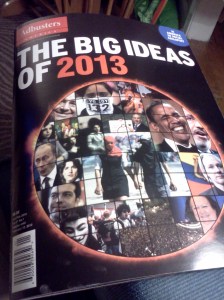
The cover of the Adbusters issue in question.

Tonight when I reached the end of the month’s issue of Adbusters I discovered they had printed the letter I wrote them back in on Oct. 2nd.

If there’s a magazine anywhere with sharper intellectual chops and bigger balls I’d like to see it.  Sure, I know it’s just a letter.  But just seeing something I wrote show up in a magazine of this caliber is inspiring.

IMG_20121203_220123

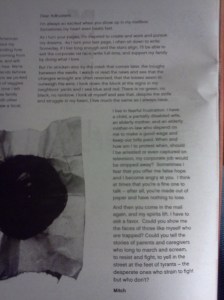
My letter takes up half the page.

If you’re interested, here’s it is.

——————————————

Dear Adbusters:

I’m always so excited when you show up in my mailbox.  Sometimes my heart even beats fast.

Reading you is like listening to a stirring piece of music.  As your pages turn I’m inspired to create and work and pursue my dreams.  When I’ve turned your last page I often sit down to write.  Someday, if I live long enough and the stars align, I’ll be able to exit the corporate rat-race, write full-time, and support my family doing what I love to do.  I celebrate you, my paper friend, who comes by mail to visit awhile and offer support.

But I’m stricken also by the crash that comes later, the troughs between the swells of your visits.  I watch or read the news and see that the changes that are wrought are often reversed, that transformations in the world at large rarely last, that the losses seem to outweigh the wins.  For every corporate defeat there are two corporate success stories.  I look down the block at the signs in my neighbors’ yards and I see blue and red, but mainly red.  There is no green, no black, no rainbow.  I look at myself and see that, despite the strife and struggle in my heart, I live much the same as I always have.  I have made few sacrifices.

I live in fearful frustration.  I have a child, a partially disabled wife, an elderly mother and an elderly mother-in-law who depend on me to make a good wage and keep our bills paid.  When and how am I to protest when, should I be arrested or even captured on T.V., my corporate job would be stripped away?  Sometimes I fear that you offer me false hope and I become angry at you.  I think at times that you’re a fine one to talk — after all, you’re made out of paper and have nothing to lose.  Wouldn’t it be better, I think at these times, to just ignore you and acquiesce?  To just watch T.V. and wait for the weekends and party like everybody else who isn’t unemployed.  Wouldn’t I be happier?

And then you come in the mail again, and my spirits lift.  You do so much for me, I feel guilty for asking, but I have to ask a favor.  Could you show me the faces of those like myself who are trapped between the threat of jail and their responsibilities to others?  Could you tell the stories of parents and caregivers who long to march and scream, to resist and fight, to yell in the street at the feet of tyrants — the desperate ones who strain to fight but who cannot?

Thanks,

~Mitch

Wunderkammer and Crunchholdoh

Crunchholdoh.net album cover — if you guys spot this and ask me to take this down I will.  It’s really cool though, so I hope you don’t make me.

This weekend I was cleaning out my Sanctum Sanctorum (a.k.a. “The Shed” — my workout room and ritual space) and I came across some stuff from Zinefest (either 2010 or 2011, I can’t be sure).  Among them was a zine called “Wunderkammer” by Whitney Rainey and this CD by Crunchholdoh.net.  I’m pretty sure Whitney did the album cover — her style is pretty distinctive.

Whitney’s zine is thought provoking and well worth a read.  Someday, maybe at a future Zinefest, I’ll be able to look her up and discuss the imagery.  She seems to have a fascination for patriarchal, presidential figures like Teddy Roosevelt.  Based on imagery alone, I suspect she has the same conflicting feelings toward Teddy that I do — admiration for a tough old bird who may have been forward-thinking for his time, but fearful and distrusting of what worship of these figures has become.  Like all good art though, everyone who reads it will see something different.

On the way to work this morning I put the CD in the truck stereo and was treated to the existential earwig that is Crunchholdoh (Track 5, Addressing the Homeless is still stuck in my head).  I’m not a music critic, and I’m not very hip, but I’ll try to write a review by suggesting titles for this apparently untitled record: Echoes of Atari Mindscapes, Scales of the Infinite City, Metronomes and Thought Museums, Mode: Life-Mirrors.  Anyway, with the early morning sun coming in through the truck window, it was pretty magical.

It’s so amazing that people make art that enriches other people’s lives.  I don’t even know these people, and yet they made my day.

Evolution, Politics, Religion, Fashion

The consensus model of human evolution is that we originated in Africa and from there migrated to the rest of the world.  The phantom concept known as “race” is the result of adaptation to environment, isolation, and cultural favoritism toward certain traits.  To oversimplify, if your gene pool lives in a cold, cloudy and remote place and your culture thinks blue eyes and blond hair are pretty, eventually you get vikings.  Race is just a way to categorize people by how they look even though we’re all the same species.

As a result of transportation, communication, and changing attitudes, interracial marriage rates are on the rise.  We are well on our way to returning to our origins — a single “race.”

Most rational people understand that anyone obsessed with racial purity  is a prejudiced, backward-looking, dangerous numbskull.  Race has all the significance of a fashion trend.  Trying to preserve racial purity is like fighting to keep bell-bottoms forever in style.  Only way more dangerous.

In prehistory, before cities, governments, and agriculture, when we wandered out of Africa as hunter-gatherers, we were in familial bands with the same politics and religion.  Agriculture came into fashion and we began to settle down in one place, which gave rise to the idea of city-states.  At that point we were still able to say with some certainty that our neighbors were of the same basic political and religious persuasion.  But still, there was increasing friction.  It’s no coincidence that the world’s oldest city is in Sumer and that’s also the home of the world’s oldest legal code.

Technology is having the same affects on politics and religion that it is having on race.  Every technological advance has had an impact.  The printing press ushered in the democratization of knowledge (without Gutenberg there would be no Protestantism) and that trend has continued and intensified, now culminating in the modern internet.

Just like “race,” the idea of the city-state is dying.  Not only can we no longer rely on our neighbors to look the same, we can no longer rely on them to be of the same political or religious persuasion.  Just as we are returning to our original “race” we are returning to our original social structure — family units with overlapping views on politics and religion.  In fact, we’ve progressed so far so fast that even that isn’t a certainty.  According to this Washington Post article, “15 percent of U.S. households were mixed-faith in 1988. That number rose to 25 percent by 2006, and the increase shows no signs of slowing.”

The idea of a nation united around a single set of cultural beliefs is an obsolete fashion.  Trying to preserve it is like trying to keep everyone riding penny-farthings instead of mountain bikes.  Only way more dangerous.

Our political and religious systems are not keeping up with our evolution.  Religion is doing better, I suppose because it’s far easier to change how you think about God than it is to change how you’re governed.  Religions that are adaptive and forward-thinking are doing better than those that refuse to let go of the past.  The fastest growing Abrahamic religion is Islam at 1.84% annually.  Compare that to Wicca at 143%.  No, I didn’t forget the decimal.  That’s 77 times faster than Islam.

Politically we’re still holding onto outmoded notions, and it shows.  Here in the U.S. we have a deeply divided congress and we just had a presidential election that, for all intents and purposes, was a tie.  Trying to force half of a country to live the way the other half wants to live is as ridiculous as making everyone wear leisure suits and platform shoes.  Only way more dangerous.

Economics is faring just as poorly.  For generation after generation the growth model of economics has been the black tie of the ball.  Now that we know that there are too many people on the planet, resources are running out, and climate change is a real threat, the growth model is looking pretty mush busted.  Old ideas about economics failed to predict the 2008 financial collapse and only a handful of people are questioning why nobody is rewriting the economics textbooks.  Nobody’s talking about how to get everyone employed and fed without growth, or talking about how to reduce our population.

Across the world there are people holding on to the old ways, and they come in all colors and styles.  Sometimes they’re plainly outfitted as fundamentalists or conservatives, but other times they dress up and play progressives.  It’s all so tiresome and outmoded.  Politics today is like a fashion show from the 1950s.  Only way more dangerous.

Let’s embrace our evolution and move on to new ideas — shrug off our old outfits and put on some fresh clothes.

Chris Baty: The Terribleminds Interview

Good interview. Chris says that the skill he would bring to the war to stop the robot apocalypse is his ability to “make weapons-grade coffee.” I’m so stealing that. Chris Baty Interview at Terribleminds