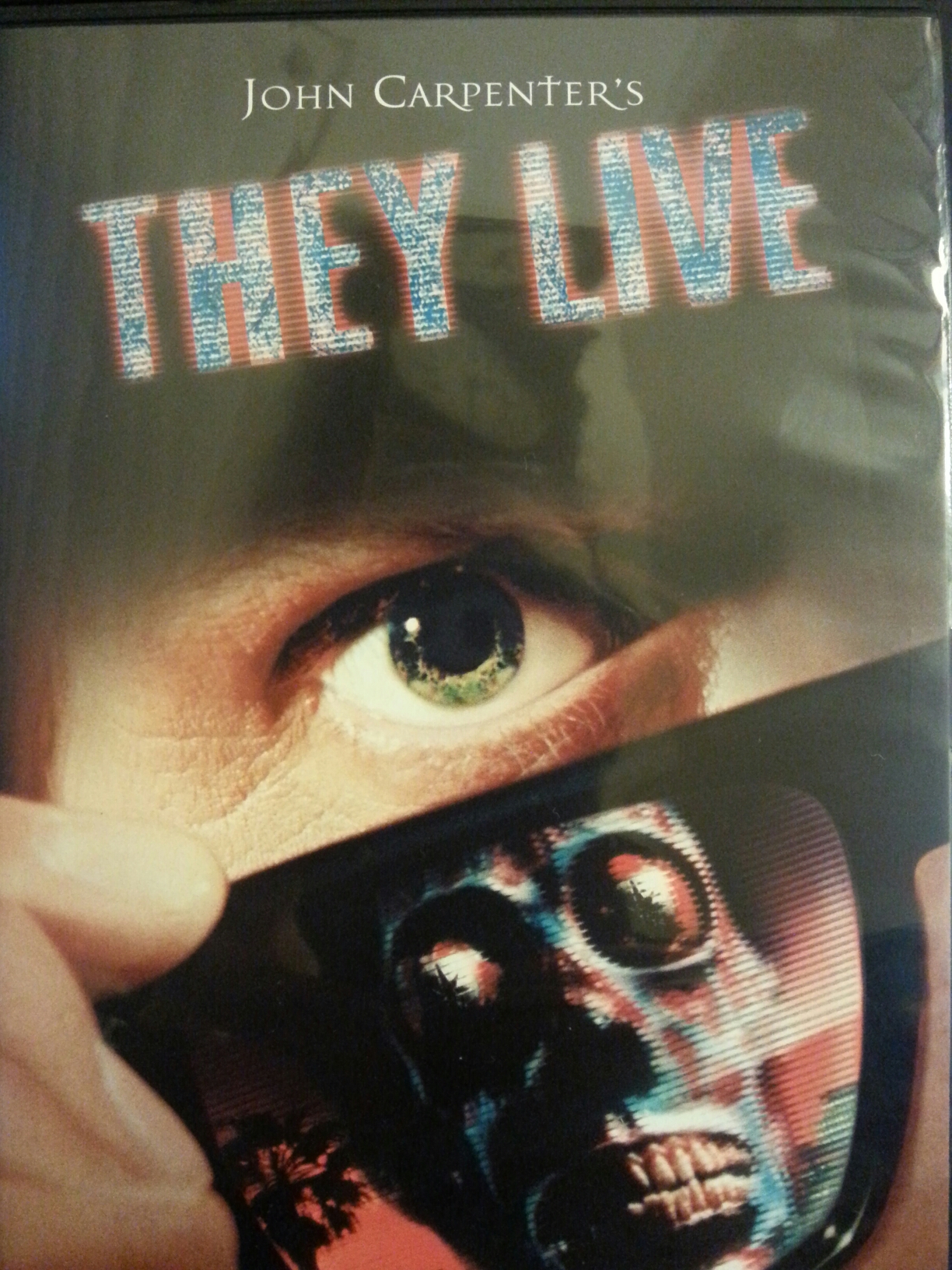
A few months ago some folks at work overheard me talking about how much I love the movie They Live. Bless their little souls, yesterday they gave me the DVD as a Christmas present. I watched it as soon as I got home last night.
Let me now explain to you why you must see it, and why the holiday season is the perfect time to do so.
The movie is based on a story by Ray Nelson called “Eight O-clock in the Morning.” Ray is now 83 years old and is remembered primarily as the inventor of the airplane propeller beanie. But he could just as well be famous for teaming up with Michael Moorcock to smuggle banned books out of Paris, for teaming up with Philip Dick to write The Ganymede Takeover, or for being friends with Allen Ginsberg and William S. Burroughs. If you know anything about the wacko, counter-culture, Beat Generation friends that Ray cultivated, you now have an idea what to expect from this tale.
Carpenter’s version of the story isn’t perfect. The tone is mixed, switching from comedic to creepy at the drop of a hat, and the effects are rather uneven (some of them are quite good by 1988 standards, others are just plain awful). It’s a low budget production for sure, and there are times when you cringe at the sets. The movie starts off a little slow.
But when the hero, played by pro wrestler Roddy Piper, puts on the sunglasses and utters one of the best movie lines in movie history, you better hold on to your seats. “I am here to chew bubble gum and kick ass,” Piper says. “And I am all out of bubble gum.”
They Live is a scathing critique of commercialism, advertising, greed, and our entire society, but it manages to get it done without preachiness or pretense. Is it perfect? No. But watching this movie is like finding a diamond ring in your Velveeta, and when you’re done you may not look at your TV, your boss, or your congressman the same way again. You may even feel pretty stupid about the credit card bills you racked up to put presents under the Christmas tree.
A surprisingly good performance from “Rowdy” Roddy Piper, and a great job by journeyman actor Keith David. Directed by John Carpenter, the genius behind Halloween, Escape from New York, and Big Trouble in Little China. Dozens of memorable lines of dialogue. One of the best fight scenes in the history of cinema. Great premise.
It all comes together to make pure, B-movie magic.
Hubby recently joined a 50 km (31.25 mi) run and I went as support. Typhoon Hagupit was expected within the day but the organizer declared that it was a “rain or shine” event so a few minutes from their 4 o’clock gunstart on that chilly, windy morning, sixty-three determined ultramarathoners eagerly listened to instructions.
“This is a no-fuss run: No freebies, no media, no gimmicks. Just plain running.” I watched with amusement when the participants cheered to that. “They must really just love running,” I smiled to myself, admiring their passion. And run they did and at the end, they celebrated well, in their own no-fuss kind of way.
Now that’s how I felt when I went to watch an Arnis tournament recently.
The participants competed fiercely such that one lady who passed by asked how much the cash prize was. When I answered that there was none and that…
Earlier this month, on December 12th, it came to mind that it was the one year anniversary of the passing of Tom Laughlin. For the past couple of weeks I’ve been thinking hard about what I might say.
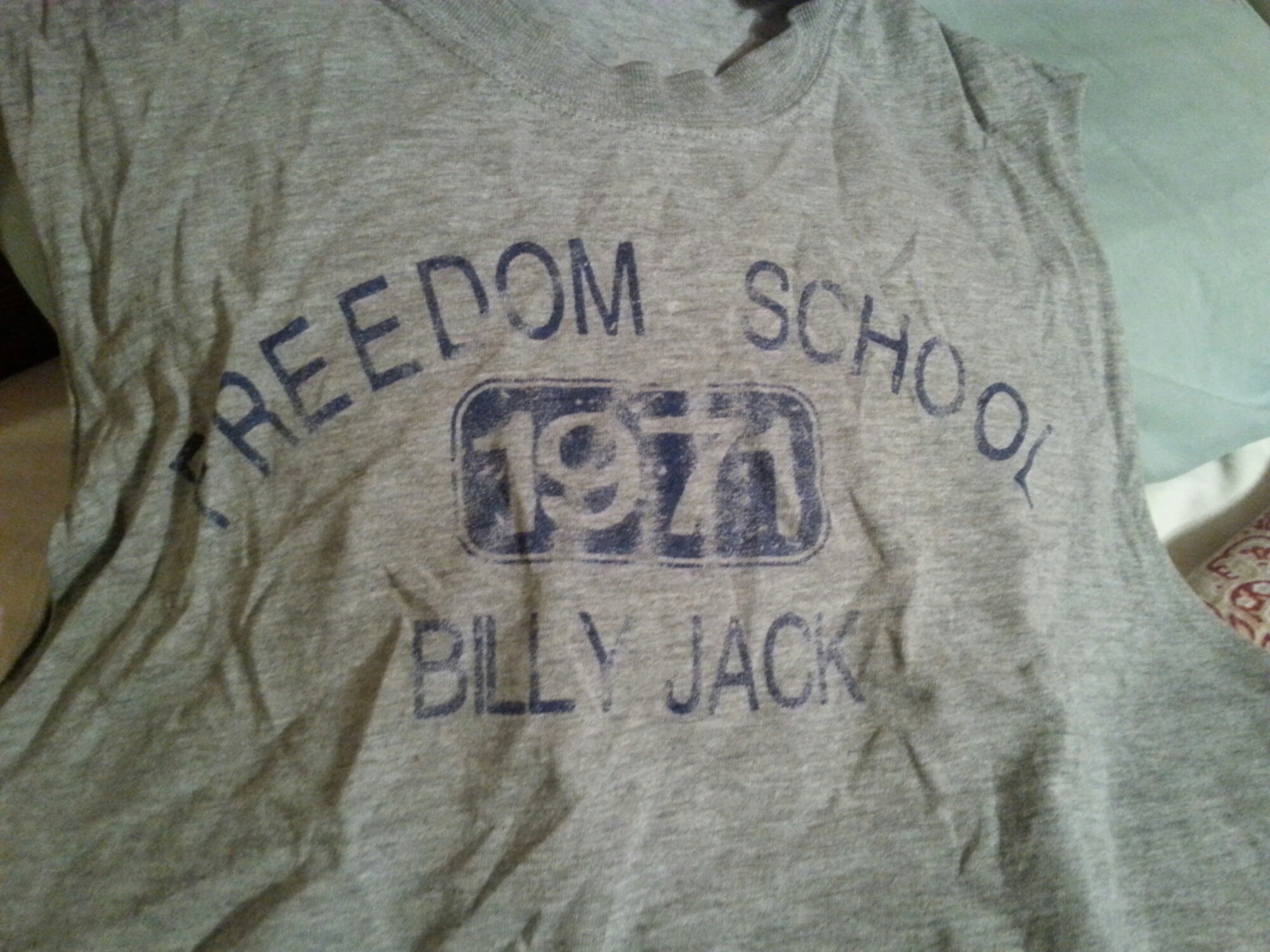
I suppose that nowadays most folks don’t even know who Tom Laughlin is, don’t remember Billy Jack, and might wonder why I’d remember or care. Laughlin was the man who created and portrayed the character Billy Jack, as well as wrote and directed the movies in which he starred.
Laughlin’s Billy Jack is a strange figure in a series of very unconventional movies. The character, and the films, are the fusion cuisine of the independent movie world. It makes no sense how good it is to have Korean BBQ and kimchi on a taco, or curried rice in sushi. It also makes no sense how amazing it is to watch Billy Jack, a former Green Beret, defend hippies from evil preppies in cowboy hats. With the acumen of a super chef, Laughlin threw everything in the pot. Billy Jack is a “half-breed” who uses “karate” (actually Hapkido, thanks to the choreography and stunt doubling of Bong Soo Han). He’s a man of peace who cannot keep his temper, a strong and quiet loner given to the occasional soliloquy, a crazy mix of cultures, perspectives, and personalities.
And the movies are just as schizophrenic as their main character, slipping back and forth between genres as easily as a shuttle through a Navajo loom. These things are equal parts pulp, action, drama, and political thriller. You might see kids singing kumbaya in this act, and a violent rape scene with exposed breasts in the next. One movie he’d be karate-chopping a pedophile. In the next he’d get appointed to a Congressional seat. You never knew if he was going to go on a vision quest or barricade himself in a building with a rifle.
And so you see, Billy Jack is America in all it’s bi-polar glory.
We Americans can’t agree on anything, not even what we are or what we stand for. But dammit, we know what we are and what we like when we see it, and we flocked to the theater in the millions to see Billy Jack right wrongs in all his wacko glory. It didn’t matter if you were a hippie or a square, a commie, a Republican or a Democrat, you were a fan.
As a kid Billy Jack inspired me to stand up against bullies and racists on the schoolyard. Later, as a young father badly in need of exercise, discipline, and character development, Billy Jack was on my mind when I turned to Korean Karate for help (and truth be told, so was Kwai Chang Caine). The martial arts transformed me. They are a part of me now. Those who knew me then no longer recognize me.
Later still, during Tom’s two presidential runs, he taught me about activism, politics, and what’s wrong with our two-party system. He never got equal time on TV, but once the internet took off, you could watch his videos and read his articles. He loved to punctuate his stuff with all caps, and the old website wasn’t the greatest. But you could just tell how much he deeply cared about his country and all its people. Tom’s enthusiasm and energy blasted off the webpage.
And you could also read about Jungian psychology, which just so happened to be relevant to my studies in mysticism and self exploration. Tom was an internationally renowned expert on Jung, a sought after lecturer on the subject. If he had never made a single movie and had never run for president, he’d still be remembered for his work in Jungian studies.
I’d like to think that if Tom was still around we’d see eye-to-eye on a lot of things. I always fantasized that I might someday get permission from Tom to write some novels featuring his character. With Tom gone, and his endearing wife Delores suffering from Alzheimer’s, that probably won’t ever happen.
But, like Tom and his character Billy Jack, I’ve never been one to give up just because it’s impossible. I sent an email to his estate. I offered to write a Billy Jack novel and donate 100% of the proceeds to the care of Delores Taylor.
What can I say? I allowed Tom and his amazing character to inspire me. Would I have turned out like this if I’d never met Tom or Billy? Who knows. I just know that lots of things will inspire you, if you’ll just let them.
The conversation takes place over a soup can telephone. The signal is weak and the line has to stay tight. Whatever is said can’t be recorded or digitized, only described later in he-said-she-said fashion.
Some writers have gotten it done, have vibrated the string and sent an intelligible message. Melville, Salinger, Palahniuk. You are not your wooden leg, your poppy petal mask, or your fucking khakis.
You are not anything that can be described.
Language is only description: metaphor, simile, dualism. This and that. Is or is not. Language can get you started but, in the end, it’s still just sounds on a soup can telephone. It cannot establish a clear line of communication.
The shorter the string, the stronger the signal. What if you trimmed it from twenty feet down to ten? Better. Ten inches instead of ten feet? Better still. But what if you made it infinitely short, eliminating it all together? Left with just two cans, what’s the point?
Why not ditch the cans all together and sit cheek to cheek with the Universe, God, the All, with your lips at her ear and her lips at yours? Why not whisper back and forth, quiet, true, and clear?
I teach free of charge through Heritage Arts , a 501(c)(3) educational charity offering free or donation-only classes related to martial arts, fitness, outdoor skills, and spiritual development. Distance learning programs available. Visit the Heritage Arts website to find out more, or click here to join the Heritage Self-Defense group on Facebook.
What is Heritage Rough ‘n’ Tumble? It’s mind-body-spirit form of American Rough ‘n’ Tumble, which began as a manner of no-holds-barred fighting in the Southern Virginia backcountry during the Colonial Era and has since grown, evolved, and adapted to the realities of modern self-defense. An amalgam of the varying techniques brought to America by colonists from all over the world, blended with the fighting methods of the over 900 distinct indigenous tribes, American Rough ‘n’ Tumble is perhaps the world’s most fearsome martial art.
SUPPORT MY MISSION
Make a tax deductible donation
Schedule a 30 min Meeting
Those in need of pastoral care, looking for interviews, wanting discuss my books or videos, etc. please click here to schedule a half hour meeting.





 Click here to download my eBooks from Smashwords.com in multiple formats, or visit these links to get them at Amazon, Barnes & Noble, Kobo, and Books2Read.com

 Robert Mitchell Jr.