Tag Archives: abraxas

Book Review: The Search for Abraxas

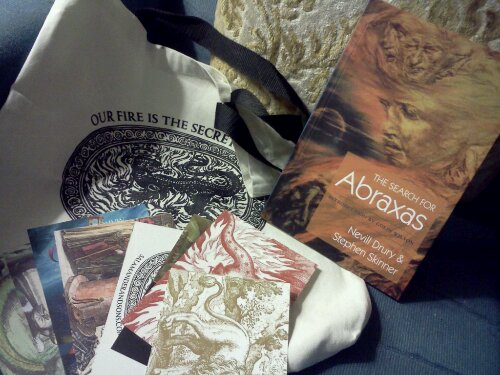
This is what was inside the envelope.

The Search for Abraxas

I went after this book like a duck after a June bug, mainly because I have been involved in my own search for Abraxas for several months and I wanted to experience alternative perspectives.

The first praise I want to shower on the book is that the writing is solid and intelligent, and the volume is well edited.  There are no run-on sentences, no typos, and although there is some speculation on the part of the authors, there are none of the lunatic ramblings one often finds in occult books.

The volume is in three sections.  Section I contains an excellent overview of Gnosticism and Qabalah.  For those knowledgeable about neither, this alone is worth the price of admission.  Abraxas, the transcendent Gnostic deity who is good and evil in both extremes, is supposed to be the thread that sews the three sections together.

But in Section II, which delves into the work of Austin Osman Spare, witchcraft, and Meso-American mythology, the authors get into the weeds.  The thread is lost and the promise of Section I begins to dissipate.  Although interesting, this section almost seems to belong in another book.

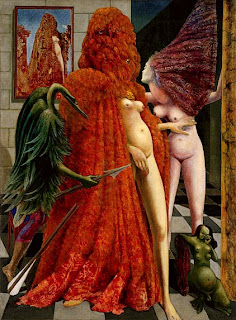
On the other hand, I must say that the color plates (paintings, drawings, etc.) are outstanding, and feature the works of Austin Osman Spare, Harry Clarke, Hans Voight, Edmund Dulac, Wolfgang Paalan, Max Ernst (“The Robing of the Bride” gives me chill bumps), and Drury himself.  These are A+.

Sections III and IV, the final more than the former, get the caravan more or less back on the road.  To quote the conclusion,

“There is an animal in man, and there is a God in man.  in order to produce a harmonized microcosm these aspects of our nature have to be firstly acknowledged: it is then that the self may be transformed.  Perhaps the God which best symbolizes this mystical venture is the one who is both man and a hawk; He who is of the Sun and whose legs are coiling serpents, symbol of Wisdom reaching down to Earth.  He who holds the sacred shield…and whose name is Abraxas.”

Nevill Drury sums it up in his introduction to the Second Edition: “As co-authors of this reissued work Stephen and I both hope that new readers will find much that is worthwhile in the pages that follow, despite the fact that in several of its key themes The Search for Abraxas has been overtaken by more recent scholarship and research.”

I wasn’t at all disappointed, but neither was I blown away until I contemplated the fact that was written over forty years ago.  It is a remarkable book, a ground-breaking book, and for that reason alone it is recommended.  It was ahead of its time.


The Search for Abraxas

The envelope.

The envelope.

I ordered The Search for Abraxas months ago.  Apparently there were some delays from the printer.  But Salamander and Sons was responsive to requests for updates and put up with me gently (everyone knows I stink in the patience department).  It came on Saturday, from Thailand.  There’s something so exciting about getting a package from a faraway land, isn’t there?

wpid-IMG_20131207_165041.jpg

The postmark.

Not only did they ship me the book, they included a selection of postcards, a book mark, and a cloth shopping bag (which I used to carry my free-range eggs home from the market yesterday).

The quality of the book itself is excellent.  This is no print-on-demand production.  The weight of the cover is impressive and the beautiful and glossy color plates are perfect.

This is what was inside the envelope.

This is what was inside the envelope.

Everything about the experience was top shelf.

For a review for the book you’ll have to wait.  I gobbled it up in just two days and the material is fairly dense.  A re-read is definitely in order.

A tip of my hat to Salamander and Sons for the great service, the quality product, the free gifts, and for transforming the purchasing process from a mere transaction into a pleasant and memorable experience.

Aidan Kelly’s Article Pushed My Buttons

“I spend about as much time as any other well-informed person being concerned about the problems America is facing and, like everyone else, not having a clue about what I can do to help ameliorate the situation. I feel that I should be doing whatever I can. I certainly agree with Edmund Burke’s observation that evil can triumph only if good people do nothing. But evil has no objective, ontological existence. It consists entirely of the absence of the good, as darkness is merely the absence of light, not a black fog that can overwhelm the light. Only adult human beings can intend evil, and evil is always intentional. It is simply gratuitous malevolence, the intent to harm another human being (or perhaps any living being) when doing so is unnecessary. As Scott Peck argued, evil is a mental illness. It could conceivably be cured and eradicated. And that should be a goal of any and all genuine religions.”
~Opening paragraph of  Why We Must Help Those Who Cannot Help Themselves by Aidan Kelly
Aidan, I respect the work you’ve done and the places you’ve been.  I salute the successes you’ve enjoyed.  I can tell your heart’s in the right place.  But this article is just plain awful, and as much as I’d like to stay off your lawn, I have to express my feelings.  Let me begin by saying that the reason you feel clueless is that you’re standing on shaky philosophical ground.
Your definition of evil is undeveloped at best (and at the worst dead wrong).
Evil is the absence of good?  Evil is not only perpetrated by humans?  Your statements sound like ideas my first grade teacher might have taught me back in ’68, back when we all started the day by reciting the Pledge of Allegiance followed by the Lord’s Prayer.  Now we know that chimpanzees perpetrate massacres, ants wage genocidal wars, and cats torture prey they plan to kill (eventually) but never eat.  Ever been attacked by a dog?  I have, and that bitch was evil.
Tying evil — and by extension good also — to humans was was your first mistake.
People are animals.  We’re never going to make progress on any front, socially and especially environmentally, until we realize that the Great Chain of Being is one of the greatest and most damaging lies ever promulgated.  Humans are not better than animals, who are not better than plants, who are not better than insects.  Every living thing is necessary and equal in the web of life.  We’re all evolving and everything is possible.  On a long enough time line, provided we don’t exterminate them all, a Bengal tiger is going to write a book that reads like something by Anton LaVey.

Your second mistake was that you failed to distinguish between Evil (with a capital “E”) and evil (with a little “e”).  “Evil” is quite a bit different from everyday “evil.”

Jung understood this better than anyone.  As he said, “The unconscious is not just evil by nature, it is also the source of the highest good: not only dark but also light, not only bestial, semi-human, and demonic but superhuman, spiritual, and, in the classical sense of the word, ‘divine.'”  The evils (with a little “e”) you rail against later in the article, and rightly so, are better called by their specific names — perfidy, greed, maliciousness, and so on.  Those evils with a little “e” spring forth from the unconscious.  They aren’t going anywhere.

Big “E” evil is just as powerful and important as big “G” Good.  As Jung said in The Seven Sermons to the Dead, in which his supreme god was Abraxas, “What the god-sun speaketh is life. What the devil speaketh is death. But Abraxas speaketh that hallowed and accursed word which is life and death at the same time. Abraxas begetteth truth and lying, good and evil, light and darkness, in the same word and in the same act. Wherefore is Abraxas terrible.”  Jung’s vision isn’t unique.  Every pantheon has an evil deity or two, except Christianity.  But then, Jung would have remedied that by making the trinity a quaternity if he’d had his way.

In short, little “e” evil is ubiquitous, normal, not unique to humans, stems from the unconscious, and therefore can’t be eradicated.  Big “E” Evil is part of the Godhead, and therefore it can’t be eradicated either.  So it doesn’t matter whether you meant ‘evil’ or ‘Evil.’  Either way you were wrong.

You’re a gnostic.  You should know this stuff.

You used an outmoded definition of religion.

You said that eradicating evil “should be a goal of any and all genuine religions.”  As a witch, I start to look for a fire extinguisher whenever somebody starts talking about what should and should not be considered a “genuine” religion. A religion should be about whatever a religion wants to be about.
You used to be a hippie, commie, beatnik witch.  Don’t you know this stuff?

You don’t understand the rules of the game.

Your love of the Golden Rule — you even quoted Hillel to close your article! — is destroying your chances of making the world a better place.  To quote Carl Sagan from his article The Rules of the Game, “The Golden Rule is not only an unsuccessful strategy; it is also dangerous for other players, who may succeed in the short-term only to be mowed down by exploiters in the long-term.”  The Golden Rule, is well, stupid.  It just doesn’t work.

You aren’t going to have a tinker’s chance in hell of making the world a better place if you don’t understand the game.

Don’t get me wrong.  I don’t have all of the answers.  It’s just that, because I’m on solid philosophical ground, I don’t feel clueless.  I feel small and insignificant.  But with the help of my Gods, spirits, and familiars, I’ll do what I can to fight evil — the little “e” kind — as hard as I can.