Category Archives: Mysticism

Camille Flammarion and WOOTW #19

From the NASA page: ‘even though this illustration has appeared in numerous places over the past 100 years, the actual artist remains unknown. Furthermore, the work has no accepted name…The illustration, first appearing in a book by Camille Flammarion in 1888, is used frequently to show that humanity’s present concepts are susceptible to being supplanted by greater truths.’

Thanks to a post by my pal Phil, I was inspired to read about astronomer, writer and psychic researcher Camille Flammarion.  Flammarion is a fascinating figure, kind of the Carl Sagan of the 19th Century.

It makes sense that was a Theosophist, which basically means he was into “open-minded inquiry into world religions, philosophy, science, and the arts in order to understand the wisdom of the ages, respect the unity of all life, and help people explore spiritual self-transformation.”

I was struck by the following quote from his 1893 book La Fin du Monde (The End of the World), a sci-fi novel about the eventual death of Planet Earth.

“This end of the world will occur without noise, without revolution, without cataclysm. Just as a tree loses leaves in the autumn wind, so the earth will see in succession the falling and perishing all its children, and in this eternal winter, which will envelop it from then on, she can no longer hope for either a new sun or a new spring.  The universe is so immense that it appears immutable, and that the duration of a planet such as that of the earth is only a chapter, less than that, a phrase, less still, only a word of the universe’s history.” — Camille Flammarion, La Fin du Monde (“The End of the World”)

How can a description be so sad and yet so beautiful?

And now for the Cabal Fang Workout of the Week — WOOTW #19.

  • 20160826_083934.jpg10 x 10 Pop Combo Drill.  Set timer for 10 minutes.  Throw 10 punch-kick combos, each one including a Shoulder Pop.  Then take 10 breaths for rest.  Repeat until timer beeps.  Pro tip: Choose 3 or 4 of your favorite combos, insert pops, and work the hell out of ’em.   Need combo ideas?  Try Left Jab, Right Shoulder Pop, Right Roundhouse, or Left Jab, Right Cross, Left Shoulder Pop, Left Roundhouse.   Hit your heavy bag if you have one.  If you don’t, strike the air — just make sure you imagine a target in 3-dimensional space.
  • 10 minute Calisthenics Half Pyramid.  Set timer for 10 minutes.  Start with 1 rep each of Hop/Clap Push-up, Rear Lunge (per leg), and Bodybuilders.  Then do 2 of each, then 3 of each, etc. taking as few 12-second breaks as you need.  See how high you can climb before the timer beeps.  Try to get through of 7 of each (1+2+3, etc. is a total of 28 reps per exercise).

CFCOV4Did you like this post?  Are you in search of metaphysical or martial mastery?  A connoisseur of Cabal Fang?  A card-carrying cohort of combat culture?  Pre-order my up-coming martial arts book here:


Basic Buddhists, Bad Buddhists — Bulletin for the Study of Religion

I found author Adam T. Miller’s relativistic challenge of “basic” vs. “bad” absolutely fascinating.  In the end, as Miller points out, the counter culture in some way supports the culture.

The metaphysician or mystic apprehends that labels are lies, maps are not the terrain, and all actions are merely techniques with results.  The monk, for example, who abstains from eating meat experiences certain things that may be beneficial.  Another monk who defiles himself by imbibing urine experiences things through transgression that might be beneficial.

Each may be an effective mind expanding technique depending on the circumstances and his or her personal developmental needs.

——————————————–

by Adam T. Miller — A few days back, the Bulletin’s own Nathan Rein asked the hive-mind that is Facebook to fill him in on what it means to be “basic.” In the ensuing discussion, someone shared a link to a Bustle piece titled “How to Spot the Basic Bitch: A Field Guide.” In the article, brief mention…

via Basic Buddhists, Bad Buddhists — Bulletin for the Study of Religion

The Temple Bell: Hermetic Antidotes to Modern Problems

20160724_213930.jpeg

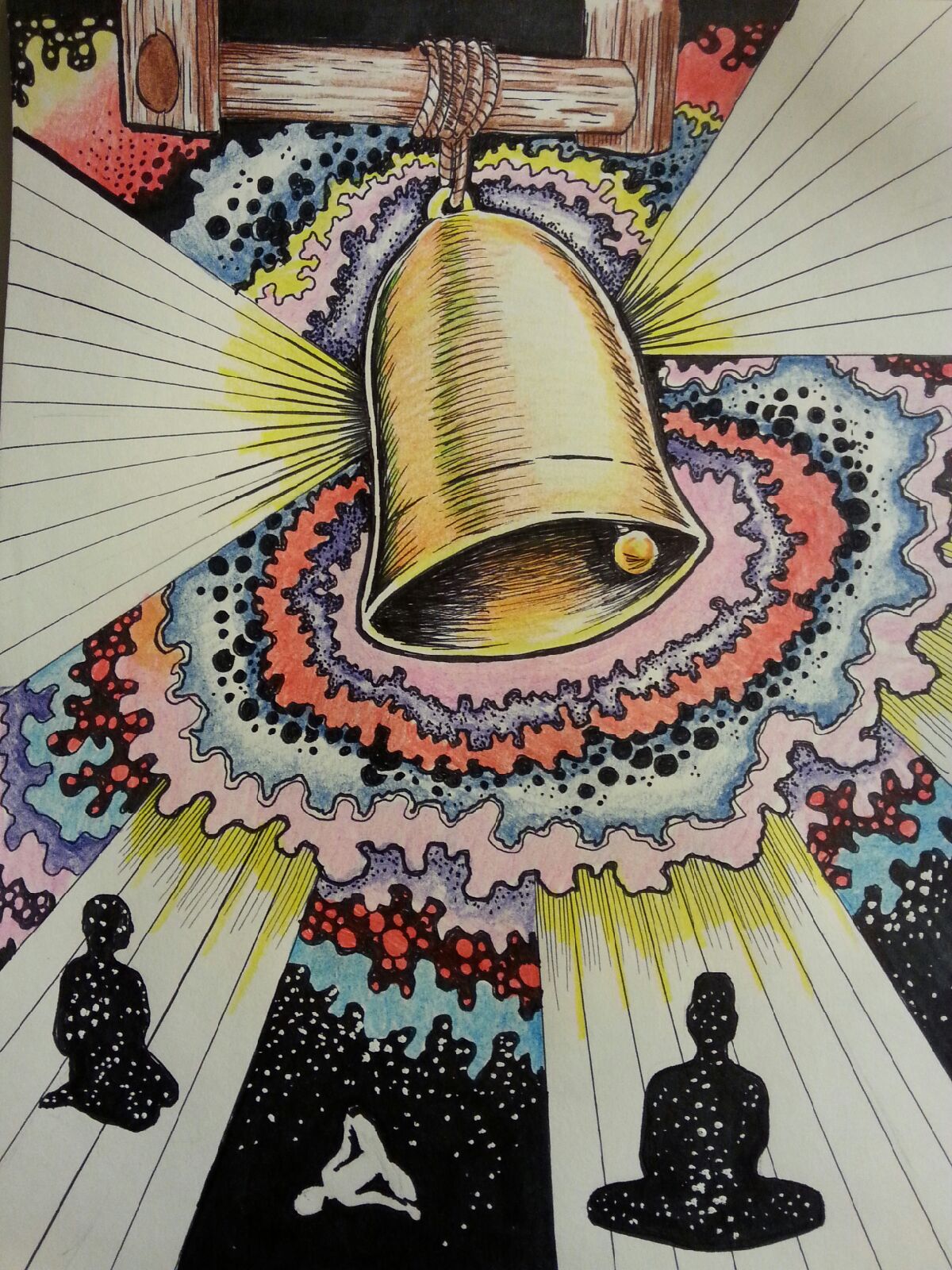
(The drawing of a bell pictured above is an illustration I did on Sunday for the upcoming book.  Pre-order links here.)

Bell — /bel/ From Middle English belle, from Old English belle ‎(bell), from Proto-Germanic *bellǭ, from Proto-Indo-European *bʰel-to sound, resound, talk, roar, bello

Each morning, before I perform the temple rites in the Cabal Fang Temple, I ring the temple bell.  I think it’s interesting, and not at all coincidental, that one of the Proto-Indo-European roots of the world “bell” is “to talk.”

Whether you are in the East or the West, in a church, shrine or temple, the ringing of the bell is the first phrase in a conversation between the universe, the space, and all the people who hear.

***

During a contemplation session last week I was struck by a bolt of insight into the problem of political polarization and extremism, and the remedies that came to me had a great deal to do with communication — how we talk with one another in the world today.

I’m no expert in International Studies, Political Science, Sociology or even Psychology.  I could be way off base.  But what I saw makes so much sense to me that I humbly present it here for your consideration.

The Formation of Polarized Groups

People who feel threatened by increasing modern pressures — economic, climatic, spacial and social — seek refuge in past securities.   Our ever-changing world, complete with social media, increasingly fast travel and communication, and dizzying technology, causes disoriented people to reach our for the stability of the way things used to be, to find solace in the traditions of their forefathers, and to generally turn away from the future and look to the past.

This is why there are so few extremists who are futurists.  Most extremists are fundamentalists trying find their balance in what they perceive as a topsy-turvy world.  They are, for the most part, people trying to preserve a way of life that is in the process of passing away.

The Tendency of Polarized Groups to Grow Increasingly Extreme

Most of us have at some point owned an insulated bottle of some kind.  These wonderful inventions are excellent for keeping things hot or cold.  However, most of us have also discovered to our dismay that if the bottle is left forgotten in the bottom of a bag, backpack or purse for a few days, removing the top can be an unpleasant experience.

In fact, even if an insulated bottle is promptly washed and dried after use, simply storing it with the lid sealed tight can result in the eruption of a sour, unpleasant smell when the “clean” bottle is opened.  This is because there is always just a little biological matter left inside.  It doesn’t take long for the aerobic bacteria use up all the oxygen inside the closed container, leaving the perfect environment for anaerobic bacteria to take over.  This doesn’t happen if the bottle is stored with lid off.  Anaerobic bacteria find it hard to thrive in the presences of ample oxygen.

The same thing happens to insular groups.  When groups are closed off from the rest of society, moderate voices die off leaving only the most extreme voices within the closed container.

Why Violence Can’t Eradicate Extremism

Physical attacks against insular groups can only be attempted when the container exists in the real world, and even then, it feeds more anaerobic growth in the virtual container of the internet.  In other words, when an extreme group exists as a physical unit — for example a group of terrorists takes over a village or builds a military compound — it can be attacked and the extremists liberated, assimilated, arrested or killed.  The physical container in which the extremists are contained, in which extreme ideas and activities are incubated, is smashed and oxygen is introduced.

Unfortunately, as we have seen so often, extremist groups on the internet seize on these interventions to make martyrs and heroes out of the fallen, which in turn feeds more extremism inside an affiliated virtual container, which then creates new members of virtual groups who are eventually radical enough to take action in the physical world.

This life cycle is akin to that of a hookworm.  The creature must pass through the human gut in order to reproduce, and extremists must pass through their online groups before they take action.  Thus we cannot hope to dissipate polarizing, extremist ideas in just one realm or the other.  We must take simultaneous, ongoing action in both worlds.

The Significance of Noetic Polities

no•et•ic: From the Greek noēsis / noētikos, meaning inner wisdom, direct knowing, or subjective understanding.

Virtual political groups, or “noetic polities,” are now more significant than physical political groups, or what we used to call “city-states.”  Noetic polities form online, inside various forms of social media, and create their own versions of reality.  With viewpoints uncontested,  insulated from external experience and evidence, and fixated on the needs and wants of their particular group, noetic polities are the norm.  People make “friends” and share “likes” with those whom they agree.  You may have a “friend” in your virtual network who has opposite political opinions for a short time, but eventually he or she will exit your group and join another one in which views are shared.

This is why we can’t compare curated media — newspapers and television — to the internet.  An individual cannot control what is in the newspaper or on the television.  You can’t “unfriend” the Washington Post.  But you can choose to get your information from just one or two sources and unfriend anyone who disagrees with what you post and share.

Few of us really know how our physical neighbors feel about political and/or social issues.  No longer can we be assured that everyone in our country shares the same political and social mores.  It is however quite likely that the majority of the individuals in our virtual circles do.  Each of us is a member of a noetic polity of our own creation and curation.

When noetic polities band together and become large enough they may dare to burst onto the physical scene.  Sometimes when this happens it is a terrible shock to members of other noetic polities.  This is because, although these groups are co-mingled in the same city, state or country, neither knew the other existed because there are 10,000 miles of virtual distance between them.  For example, many were shocked in 2014 when ISIL seemingly appeared out of nowhere and began seizing real estate.  In actuality the group had been around since at least 1999 in both the virtual and actual worlds.

The Hermetic Solution

her·met·ic: From the name of the mythological figure Hermes Trismegistus and/or Greek God Hermes whose name likely stems from the Proto-Indo-European root –s(h)er “to bind or bring together.”  Of or relating to an ancient occult tradition encompassing alchemy, astrology and, most importantly, the power of sacred geometry and symbol.

As we’ve seen, insulated groups are breeding grounds for the bacteria of negativity, selfishness and even violence.  In order to break the life-cycle of extremism and prevent its growth, we must focus on breathing oxygen into insulated environments where extremism grows — in both virtual, noetic polities and in the physical world as well.

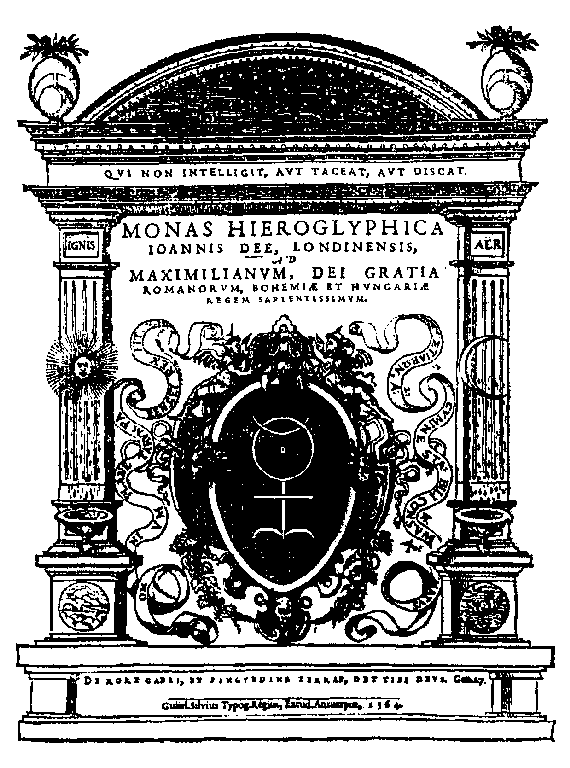
This approach is not new.  Hermeticist John Dee dreamt of stopping religious war and strife.  In his day there was no internet.  He sought to use instead the imaginal realm of symbols.  His hope was to uncover the Perennial Wisdom, the original prehistoric religion of man, and to unite the world beneath its grand symbol, the Monas Hieroglyphica.

The essence of Hermeticsm is the reconciliation of opposites and pursuit of non-dualism.  This kind thinking promotes the dissipation of conflict.

Proposed Strategies

Individuals or groups wanting to take action against polarization and extremism might consider the following strategies:

  • Seek to emulate Hermes, the messenger.  Hermes was the messenger between gods, and between gods and humanity.  Take ownership of your role as a reconciliatory figure.
  • Create opportunities for cross-pollination.  Regardless of social and political differences, maintain virtual connections with family members, coworkers, neighbors and members of other physical circles.  Be inclusive.
  • Avoid arguments when interacting with people possessed of opposing views.  Rather than focusing on winning, convincing, persuading, etc., concentrate instead on breathing oxygen into a toxic environment.
  • Deliberately join insular social networks and inject oxygen into the dialogue.   Reward positive behavior, ignore the negative, and propagate positive memes.  Move the trend needle in the direction of the positive and peaceful.
  • Observe the Golden Rule online.  Where discourse involves no risk of physical injury (“sticks’n’stones”) observe the Golden Rule in discourse.  Never disingenuously infiltrate a virtual group to troll, discredit, smear, promote mischief, or be evil.  This kind of behavior only encourages groups to despise and distrust outsiders.  Try to make fearful, disoriented people feel safe and comfortable.
  • Observe the Brazen Rule in the physical world.  As Confucius said, “Repay kindness with kindness, but evil with justice.”   This method of behavior modification has been proven effective by scientific research (I was first exposed to it in a 1993 article by Carl Sagan called A New Way to Think About Rules to Live By).
  • Be aware of the relationship — the flow — between virtual and actual reality.  It solves nothing to oppress voices in one realm or the other.  This only encourages the oppressed to seek refuge in an alternate reality.  Remember, it was probably fear and oppression (real and/or perceived) that made these people seek out an insular group in the first place.
  • Take part in the respiration.  You cannot hope to influence someone else if you will allow no possibility of being influenced yourself.  Put on your listening ears and practice empathy.

A Call for Realism

In summation, I would like to call upon everyone to be realistic about the world we live in.  The threat of polarization and extremism, while real and deadly, should not be feared out of all proportion.

Life expectancy is at its highest point and the world remains more peaceful and safe than it has ever been at any point in history.

Flattered, Proud and in Good Company

We’re proud.  We’re flattered.  We’re pleased as punch to be in the company of the fine folks over at the Hermetic Library which we now sponsor!

Yes, the kind librarian at The Hermetic Library has added some of our materials to the reading room.   Go, browse the stacks.  There you will find sufficient quiet, space and words to occupy many hours of happy exploration.

You’re a Hermeticist? What’s that?

Emerald Hourglass2

Update: 11/30/25:

I am no longer a Christian Hermeticist.  I haven’t been for a very long time. I’m just an Old Catholic priest.  I completely forgot this old page was here until I saw a comment come through.  I immediately considered deleting the page.  But since I’m not the sort of person who gleefully sanitizes their past, and because I think this page is a great opportunity to minister to occultists, I’m leaving it up.  Churches are seeing huge influxes of neopagans and occultists seeking healing from demonic influences.

If you are an occultist, ceremonial magician, neopagan, agnostic, Unitarian Universalist, or someone on the fringes of Christianity, then Christian Hermeticism is the first rung on a ladder that, if you continue upon it and follow it upward, will lead upward to a fuller relationship with Christ.  You will, in time, leave it behind and just become a good old-fashioned Christian.  Christianity has plenty of room for the wonderful, the mysterious, the liminal, and numinous.  Christ himself said, “Unless you turn and become like little children, you will never enter the kingdom of heaven” (Matthew 18:3).

But if you are a believing, practicing Christian who is looking for a way to explore the occult or to embrace a universalist tendency, Christian Hermeticism is a dangerous first rung on a ladder that, if you continue upon it, will lead you down to hell.  Go back up and don’t look down.  If you have questions that are causing you to stumble on the Christian path, simply ask your pastor, your priest, or even me, for help and advice.  Christians have been doing apologetics for a couple of millennia.  Rest assured, there is an answer to your question within the faith.  There is no need to go looking for answers in the occult.

Also, the Cabal Fang project is no more.  It was totally re-worked and what was valuable and non-occult was absorbed into Heritage Arts.  The book pictured below is no longer available and the old links are dead.

Regards,

~Fr. Robert “Mitch” Mitchell

Original Post:

Yes, I’m a Hermeticist. More precisely a Christian Hermeticist.

What’s a Hermeticist? Someone who studies or practices Hermeticism, which is a philosophy based on wisdom teachings attributed to a mythical figure called Hermes Trismegistus, a conflation of the Greek god Hermes and the Egyptian god Thoth.

Hermeticists believe that there are certain universal, timeless truths (“the Perennial Wisdom”) which have always been, and will always be, accessible anyone through the powers of symbol, parable, analogy, myth and initiation. Hermeticism is, in the words of the great Valentin Tomberg, the search for the “communal soul of religion, science, and art.”

This is why Hermeticism seeks to infuse all human endeavor with sacredness — to align all human activity with the Divine Will. This idea is embodied in the great Hermetic axiom, “As Above, So Below.”

There is no conflict between Hermeticism and Christianity whatsoever. Christ Logos, the Truth Itself, was with us from the beginning (John 1). Humanity’s brushes with Logos are revealed in ancient art, architecture, and philosophy. Pagan religions were human attempts to hear Christ’s distance voice. The great pre-Christian sages and philosophers were the distant rumbles of thunder before the lightning strike of Jesus Christ.

On an individual level, Hermeticists strive to unify thoughts, desires, actions and beliefs — to behave with integrity — which is exemplified in the Hermetic Quaternary: “To Know, To Will, To Dare; To Keep Silent.”

Hermeticits believe that there is no conflict between science, religion, and art. The three of them should walk arm in arm. So it’s no surprise that a list of famous Hermeticists includes scientists (Sir Isaac Newton, Dr. John Dee), authors and poets ( William Butler Yeats and Arthur Machen), artists (Pamela Colman Smith). and clergy (Giordano Bruno, William Alexander Ayton).

The mot enduring Hermetic text is the Emerald Tablet of Hermes Trismegistus, which makes a fitting end to this brief definition.

The Emerald Tablet of Hermes Trismegistus

  1. True it is, without falsehood, certain and most true.
  2. That which is above is like that which is below, and that which is below is like that which is above, to accomplish the miracles of one thing.
  3. And as all things were by contemplation of one, so all things arose from this one thing by a single act of adaptation.
  4. The father thereof is the sun, its mother the moon; the wind carried it in its womb; the earth is the nurse thereof.
  5. It is the father of all works of wonder throughout the whole world.
  6. The power thereof is perfect.
  7. If it be cast on to earth it will separate the element of earth from that of fire, the subtle from the gross.
  8. With great sagacity it doth ascend gently from earth to heaven; again it doth descend to earth, and uniteth in itself the force from things superior and things inferior.
  9. Thus thou wilt possess the glory of the brightness of the whole world, and all obscurity will fly far from thee.
  10. This thing is the strong fortitude of all strength, for it overcometh every subtle thing and doth penetrate every solid substance.
  11. Thus was this world created.
  12. Hence there will be marvelous adaptations achieved, of which the manner is this.
  13. For this reason I am called Hermes Trismegistus, because I hold three parts of the wisdom of the whole world.
  14. That which I had to say about the operation of sol is completed.

Hermeticism is the central philosophy of Cabal Fang, the non-profit martial art I founded in 2009. Sign up for the free distance learning program by clicking here, or take read my e-book and go on a 12-week journey of self-transformation.

The Legend of Tarzan Falls Flat

Two years ago, when I discovered that a new Tarzan movie was in development, I promised not to get my hopes up.  Well, I got my hopes up.  Shouldn’t have done that.  Wednesday night I went to see The Legend of Tarzan and my hopes for a faithfully adapted Tarzan film were dashed.

Fair warning:  There are spoilers coming.  And furthermore, I am about to get critical beyond your wildest dreams.  Intensely, heavily, metaphysically critical. I’m no Tarzan expert, but I’m close.  I’ve read the first eleven Tarzan books, I was a UVA English major, and I’m about to go far deeper in my exploration of the character than the writing and directing team of this movie bothered to go.

First, the good and the goodish.  Margot Robbie’s take on Jane was perfect, and that’s the only unqualified praise I have for the film.  There is only one scene in the film that is really good, and it is near the end of the film when Tarzan confesses his guilt at having killed Mbonga’s son.  This experience mirrors the character development of Tarzan when he first encounters humankind.  But it’s still dumb, because in the movie timeline, that was twenty years previous.  Tarzan should’ve had his “Aha!” moment years ago.

Next the overtly negative. Skarsgård put in a workmanlike performance, but never seemed to fully understand or embrace the role.  Christoph Walz’s character is a caricature.  I used to like him as an actor, but it’s clear he’s quickly developing a certain shtick.  Africa and its jungles are actually characters in the Tarzan books.  How can you decide not to film in Africa?  But that’s what they did, shooting the movie on a UK sound stage using liberal CGI, and it shows.  This should’ve been a breathtaking film, not a flat, 2D video game.  The scene in which Kala rescues baby Tarzan looked horrid.  Last I checked, there are still living babies on this planet, and plenty of costumers capable of making ape hands too.   Annoying.

Now for the more subtly awful.  Look, Tarzan is a wonder in the world of fiction.  Although the story may need updating for modern sensibilities, the characters and themes need no modification.  In other words, change all the plot details you want, but leave the essentials in place or else you miss the point.  I just want to scream at movie writers and directors, “You cannot make iconic characters better.  If you think you can, you’re an idiot.  Save yourself the embarrassment and stop trying!”

The message of Tarzan is that it doesn’t matter where you’re born.  If you’re a noble, hardworking and intelligent person you’ll go far in life.  Burroughs’ tales depict the inherent nobility of man, not his latent savagery.

The essential quality of Tarzan is his agility, both physically and mentally.  The Tarzan in this movie is incapable of coming up with a plan.  He staggers forward, relying on luck and the kindness of friends and animals to pull him out of tight spots.  Burroughs made it abundantly clear in the novels that anyone raised by apes, if they survived, would have been an incredible physical specimen.  What makes Tarzan special is his mind:

“But there was that which had raised him far above his fellows of the jungle–that little spark which spells the whole vast difference between man and brute–Reason. This it was which saved him from death beneath the iron muscles and tearing fangs of Terkoz.”

What makes Tarzan unique is that he is the utterly reconciled mixture of Man and Beast.  The tension between man and ape in Burroughs’ Tarzan is brief, and it lasts only for a short time after being exposed to humans for the first time.  Tarzan rejects what is bad about civilization — the hypocrisy, the fakery, the politics, the “veneer” as Burroughs calls it — and embraces what is positive.  He is no primitive paragon, no bizarre Dr. Doolittle.  He rides horses and enjoys the occasional drink  or cigar.  And yet, this writer/director team once again decides that there has to be internal conflict.  He mopes around in his London home thinking about the jungle, and when he gets to the jungle he seems reluctant to shed his proper clothes.  Poppycock.

Burroughs’ Tarzan speaks over a dozen languages, and yet he as capable of shedding his civilized veneer as he is of shedding his clothes.†  This film, like all previous attempts, doesn’t come close to getting across Tarzan’s ferocity, scarred appearance, and terrifying aspect.  No Tarzan movie has ever depicted the hideous scar on his forehead, the scar that, when he became infuriated, glowed red and pulsed like a demon.  Here’s how he got it:

Terkoz had a dozen knife wounds on head and breast, and Tarzan was torn and bleeding–his scalp in one place half torn from his head so that a great piece hung down over one eye, obstructing his vision.”

(From Tarzan of the Apes, Chapter 12 )

The bottom line is that apes could’ve done better jobs than director David Yates and writers Adam Cozad and Craig Brewer.  

This movie is awful.  But the good news is that many of the Tarzan books are in the public domain and available as free eBooks.  So do what the producers of this movie clearly failed to do — dig out your iPads, Nooks and Kindles and get to reading.  You’ll be glad you did.

————————————————–

†The Paris fight from The Return of Tarzan is a perfect example of this, and one of my favorite scenes in the entire Tarzan canon.  Ten hardened Parisian thugs — who really have it coming — decide to ambush our hero in a small hotel room.  Here’s an excerpt:

“The woman still stood where she had when Tarzan entered…an expression of surprise and then one of horror superseded the others.   And who may wonder. For the immaculate gentleman…had been suddenly metamorphosed into a demon of revenge. Instead of soft muscles and a weak resistance, she was looking upon a veritable Hercules gone mad.

“MON DIEU!” she cried; “he is a beast!” For the strong, white teeth of the ape-man had found the throat of one of his assailants, and Tarzan fought as he had learned to fight with the great bull apes of the tribe of Kerchak.

He was in a dozen places at once, leaping hither and thither about the room in sinuous bounds that reminded the woman of a panther she had seen at the zoo. Now a wrist-bone snapped in his iron grip, now a shoulder was wrenched from its socket as he forced a victim’s arm backward and upward.

With shrieks of pain the men escaped into the hallway as quickly as they could; but even before the first one staggered, bleeding and broken, from the room, Rokoff had seen enough to convince him that Tarzan would not be the one to lie dead in that house this night…”


Orlando: Odysseus, Socrates and the Limits of Common Sense

GSHG

Orlando.

The horror of what happened is penetrating.  Like the sulfurous smoke from barking gun barrels it seeps into my eyes, lungs and skin.  It makes me want to wretch, to run, to think about something else.  I see faces on television twisted by sadness.   I see videos and texts from beyond the grave.  My imagination is too strong, and my heart and mind descend into the pit of those terrifying, hellish hours.

And in the aftermath, everyone is trying to apply common sense to this tragedy.  People are drawing conclusions and making assertions about rights and terrorism and crime.  Not just policy makers, pundits and presidential candidates, but every day people like you and me.

I’m alone I think.  Whereas most everyone is making common sense conclusions and making common sense proposals, I am trying to see not just with “my gut” but gnostically, magically, mystically and scientifically.  I’m doing this because I have to take myself out of the equation as much as possible.  As Plato famously said through the semi-fictional mouth of Socrates, “Know thyself.”  In trying to know myself, I have learned that I know little, and that I am nobody.

In the myth of Odysseus and Polyphemus the Cyclops, the hero Odysseus must put aside his pride, hide his identity, and assume the name “Nobody.”  He drugs Polyphemus, and while the giant sleeps, he blinds the beast with a sharpened olive branch hardened in the fire.  When the cyclops awakens and calls to his brethren for help, all he can exclaim is that he has been attacked by “Nobody.”  His fellows think therefore that he has been blinded by the gods.  Odysseus and his men escape, but as they are leaving, Odysseus brags and gives away his name.  This allows the cyclops to pray to his father Poseidon for revenge, which comes indeed soon enough.

There are several lessons in that myth.  The first is that being selfless and putting aside your ego can help you overcome near-sighted monsters, even ones that look impossible to overcome.  The second is that sometimes your greatest weapon is the olive branch.

This myth is how I apply my gnostic sense and sight to the questions  posed by the horror of the Orlando shootings.   I’m not a policy wonk.  But if I was, I’d try to apply my scientific sense also.  I’d look at the statistics and the studies about gun violence, terror and crime.  I’d apply my magical sense, meaning that I’d evaluate and assess the hopes, dreams, desires and degrees of intent on all sides.  And of course I’d be informed by my mystical sight too, allowing myself to be open to what nature, the universe, and the One has to say.  In short, I’d legislate through the lens of the Powers of the Sphinx — “To Know, to Will, to Dare; to Keep Silent.”

The more complex the problem the less common sense applies.  Does it make any sense at all that you can’t exceed the speed of light?  That widening a road doesn’t eliminate traffic jams?  That the continent you’re standing on is moving at the rate of 1″ per year, that the earth is spinning at 1,oo0 mph while moving around the sun at 67,00o mph, and yet it feels like we’re standing still?  How can it be that, despite the evening news, the rise of ISIL, and the horror in Orlando, that the world is less violent now that it has ever been?

“Common sense is nothing more than a deposit of prejudices laid down by the mind before you reach eighteen.”  —Albert Einstein

Common sense is great for balancing a checkbook, hanging a picture, cooking a pot of lentils‡, or starting a revolution circa 1775.  Unfortunately, it really isn’t very good at solving the great questions of any advanced science — including Political Science — in an increasingly complex world.  It’s prone to faults, a leaky bucket in a world of microchips, noetic polities, and nanotech.

To move forward toward viable remedies and solutions, we’re going to have to get beyond common sense and see the world in at least four different ways — simultaneously and without contradiction.

But for now, can’t we take a little more time to just grieve and try to breathe?

————————–

“It is a Stoic belief, too, that the wise man will do all things rightly, even to the wise seasoning of lentil soup.”  This is because a traditional lentil soup contains just lentils, bay leaf, salt and pepper — another way of saying, “keep it simple, stupid.”  From The Deipnosophistae of Athenaeus (published in Vol. II of the Loeb Classical Library edition, 1928).

Ladybugs and Silicone, plus WOOTW #8

20160122_042648.jpg

One of my paintings…

Life always evolves ever more enlightened forms, with larger brains and more highly developed social structures.  Matter struggles to transform itself into something greater too, gravity being evidence of its desire to confederate, tryst, and come together.  Silicon, through it’s symbiotic relationship with humanity, strives for its maximum attainment through circuit boards, software and the virtual, mechanico-electric equivalent of Nature’s web — the internet.

In the same way that a ladybug will always climb to the highest finger on a child’s hand as it searches for a place to launch into flight, so do all things in the universe reach for the highest level of consciousness.

Everything in existence is searching for a mountaintop where it can commune with God, the One, the All.

And this is why, when I’m staring off into space, my wife no longer asks, “Whatcha thinking about honey?”

And now for the Cabal Fang Workout of the Week.  WOOTW #8 is a martial arts fitness and mobility drill that works just fine either armed or unarmed!

Set a timer for 1 minute repeating intervals. Armed or unarmed (your choice) complete 1 minute each of: 1. Step up and over 2. Crawl under 3. Jump Up 4. Crawl under 5. Push-ups 6. Crawl under 7. Jump up 8. Crawl under 9. Russian Squats 10. Step up and over. Beginners, bodyweight only. Intermediate players, add wrist weights. Advanced players add wrist weights and weighted vest.

Scriabin’s Symphonic Poem of Music, Color and Fire

Don’t ask me how I managed to avoid discovery of Russian composer Alexander Scriabin until just this week.  This is amazing, mystical stuff.

Scriabin composed music that was based on Gnostic and Theosophical concepts, and it was written to be performed on equipment that had not yet been invented in his day.  From what I’ve read, he used the best available at the time — color organs and such.

The colors and sounds of Prometheus: Poem of Fire are nothing short of mesmerizing.  Video below.  From the YouTube recap:

“In February 2010, Anna Gawboy, a doctoral candidate at the Yale School of Music and scholar of Russian composer Alexander Scriabin, attempted to realize the composer’s final work: a symphony of sound and light called “Prometheus: Poem of Fire”. To accomplish this, Anna worked closely with Toshiyuki Shimada, conductor of the Yale Symphony Orchestra, and Justin Townsend, an award-winning lighting designer.

Anna and Justin spent a year developing ideas and preparing for the performance, but a majority of the lighting work was done just days before the concert. This documentary covers the events of that week and the performance itself.”


That Jab, that Incredible Jab

Being a kid coming up in the late 60s and 70s, Muhammad Ali was an important figure for me. When my schoolmates were talking about white superiority, it was clear they had never watched Ali.

He was the pinnacle of human evolution, a natural leader who was handsome, charming and supremely athletic. Which is why most of my peers hated him with all their hearts.

Every time they hoped and prayed their white hope would dethrone him their dreams were dashed.

And when they bullied me, this doughy little white kid dreamt of being like him.  I won’t lie, I had a real tough time standing up for myself. But the day a bunch of white kids gathered around a little little black girl on the playground and started shooting off their mouths, I was finally able to put up my dukes.

Of course now we know that all of humanity is one race, or at least most of us do. Back then it wasn’t even close to settled.

Which is why I love Ali and now grieve his passing. Because he wasn’t just a player in my personal awakenIng to the oneness of race, he was part of the global awakening that began in the 60s and is still going on today.

He was the master of the jab, both verbal and literal. With a flash of the tongue or a flick of his left fist he set the world spinning like no other.

That jab, that incredible jab…