Category Archives: Martial arts

General Update: Surgery, Muscle Building, Goals, Progress, etc.

Lot’s going on in these parts!  Here’s an update on my wife’s orthopedic surgery (which is today), an update on chapel progress, one-year barbell lifting results, a rundown of the CD I just listened to and books I’m reading, and much more.  Video below.


If you liked this post you’d probably like my e-books.  Click here to download them in any format from Smashwords or purchase them wherever fine e-books are sold!

montage

Going Powhatan #4: Going to the Library

I live in Henrico County, VA.  I used to think we have a nice library system.  I was wrong.  We actually have a scintillating library system.

Back in November, as I was lining up resources and information for my Going Powhatan project I seemed to recall that Henrico County Public Library (“HCPL”) had an “ask a librarian” function on the website.  So I jumped over and took a look.  Sure enough, there it was.  “Can’t go inside on account of COVID,” I thought.  “Might as well give it try.”  I clicked the link and typed a quick message asking for assistance compiling a reading list of the most highly-referenced books on the lifeways of the native tribes of Virginia with an emphasis on the frontier period and prior (pre-1912).

I immediately got a phone call — a phone call! — from a nice librarian named Kareema (I found out later she was Kareema Hamdan, Area Branch Manager of HCPL).  She said that they were working on it and they’d get back to me.  “This is  the sort of thing that librarians live for,” she said.  I didn’t know what to expect, but I thought it would be fun to see what they came up with.  I thanked her and waited patiently for a reply.

About a week later I got the following email from Kareema which said,

Hi Mitch,

I sent out a request to our librarians for any information we could provide to assist with your research and reading list. As you will see, we gathered more than just book titles so I hope some of this information is helpful to you. Please feel free to follow up with us if we can assist further.

Thank you,

Kareemah

Librarians who contributed:

Lisa Kroll
Elizabeth Hadley
Kelsey Crossley
Barbra Salas

Below are the resources and links they provided to me.  I’m still stunned by the amount of work they put into this, awed by its comprehensiveness, and deeply appreciative for the contribution they made to the project.  I told Kareema that she and her entire team were going in the book’s dedication, and I meant it.

The most insightful resources were the two relating to depiction of Native Americans in literature.  I’m not an insensitive person, but I can be a little naïve.  I honestly felt that sincerely immersing oneself in the language and lifeways of Virginia’s Native Americans was in and of itself a gesture of the greatest respect.

It never occurred to me that a reasonable person could view this project as disrespectful or exploitative.  But when I saw the references provided by the librarians, an old memory resurfaced.

Many years ago I met a fellow who assumed my first book was by and for neo-Nazis just because it had a red and black cover that featured a crow which he thought was an eagle.  I had been gut-punched.  I assured him that my book was most certainly not in any way inspired by, associated with, related to, or sympathetic toward anything Nazi — neo- or otherwise.  But was he still laboring under the misconception?  You know what they say about first impressions.

It all came back to me and my stomach knotted like kudzu.  What if somebody misunderstood what I was doing with this project?  How could I have forgotten that painful lesson?  Back then I had an excuse.  It was my first book as a self-published, freshman author.  But I’ve written six books since then.  I hope I’m older and wiser.

Thanks to the nudge of some kind librarians, and to the memory of an old lesson re-learned, I determined to break my back trying as hard as possible to see this project the way others might.

I started by reading a couple of contemporary books by and about local native peoples — Chickahominy Indians – Eastern Division: A Brief Ethnohistory by Elaine and Ray Adkins and  The Chickahominy Indians of Virginia Yesterday and Today by Eleanor West Hertz. I will read more.  And I will also get the opinions of local tribespeople before I publish.


Print titles owned by Henrico County Public Library

  • Eastern Shore Indians of Virginia and Maryland by Helen Rountree ( Any title by Helen Rountree should be worthy of reading)
  • The Powhatan Landscape: An Archaeological History of the Algonquin Chesapeake by Martin Gallivan
  • Indians in Seventeenth Century Virginia by Ben McCary
  • The Gale Encyclopedia of Native American Tribes.  Detroit: Gale, 1998.
  • Encyclopedia of native tribes of North America by Michael Johnson
  • The Powhatan landscape : an archaeological history of the Algonquian Chesapeake  Martin D. Gallivan,
  • Powhatan Indian place names in Tidewater Virginia Martha W. McCartney
  • The true story of Pocahontas : the other side of history : from the sacred history of the Mattaponi Reservation people by Linwood Custalow
  • Pocahontas and the Powhatan dilemma : an American portrait  Camilla Townsend, Camilla
  • Monacan millennium : a collaborative archaeology and history of a Virginia Indian people by Jeffrey L. Hantman
  • The Virginia Indian Heritage Trail edited by Karenne Wood.
  • RELATION OF VIRGINIA : a boy’s memoir of life with the Powhatans and Patawomecks by Henry Spelman (on order as of 11/2020) https://www.upress.virginia.edu/title/1636
  • First People: The Early Indians of Virginia | UVA Press Incorporating recent events in the Native American community as well as additional information gleaned from publications and public resources, this newly redesigned and updated second edition of First People brings back to the fore this concise and highly readable narrative. Full of stories that represent the full diversity of Virginia’s Indians, past and present. www.upress.virginia.edu

From the William & Mary Libraries: Virginia Indian Research References

Websites affiliated with VA tribes or with tribe specific information

Publishing / Book Guidance by Native Americans about Native Americans in literature :

  • http://www.oyate.org/ “Oyate is a Native organization working to see that our lives and histories are portrayed with honesty and integrity, and that all people know that our stories belong to us.”
  • Established in 2006 by Dr. Debbie Reese of Nambé Pueblo, American Indians in Children’s Literature (AICL) provides critical analysis of Indigenous peoples in children’s and young adult books. Dr. Jean Mendoza joined AICL as a co-editor in 2016. https://americanindiansinchildrensliterature.blogspot.com/

Resources on Indigenous Virginians from HCPL Databases (you will need your library card number to access)

Ebsco eBooks High School:

Plants of Virginia

  • Britton, Nathaniel Lord, and Addison Brown. An Illustrated Flora of the Northern United States, Canada, and British Possessions: From Newfoundland to the Parallel of the Southern Boundary of  Virginia, and from the Atlantic Ocean Westward to the 102d Meridian. New York: C. Scribner’s Sons, 1913.  An oldie but a goodie, in three volumes, comprehensive and still useful although the taxonomy is dated; available online at the Biodiversity Heritage Library, https://www.biodiversitylibrary.org/bibliography/940#/summary
  • Flora of North America, http://beta.floranorthamerica.org/Main_Page Comprehensive work in progress.
  • Foster, Steven, and James A. Duke. Peterson Field Guide to Medicinal Plants and Herbs of Eastern and Central North America. Third Edition. Peterson Field Guides. Boston: Houghton Mifflin Harcourt, 2014. Of limited use without second, identifying guide; general info about medicinal use, not specific.
  • Peterson, Lee. Peterson Field Guide to Edible Wild Plants of Eastern and Central North America. Boston: Houghton Mifflin Harcourt, 1999. Drawings and photos, habitat descriptions, seasonal guides, and preparation instructions; of limited use without second guide.
  • Virginia Department of Forestry. Common Native Trees of Virginia: Tree Identification Guide. 2007. Of limited use; available as free download from http://www.dof.virginia.gov/shop/index-books.htm
  • Virginia Native Plant Society,https://vnps.org/ Has info about Virginia natives, including regional guides geared toward the home gardener which can be downloaded for free, https://vnps.org/virginia-native-plant-guides/
  • Virginia Wildflowers, https://virginiawildflowers.org/ Amateur site with identifying photos of wildflowers found in southwestern Virginia; includes limited info on edible and medicinal plants and fungi.
  • Weakley, Alan S., J. Christopher Ludwig, and John F. Townsend. Flora of Virginia. Fort Worth: Botanical Research Institute of Texas, 2012. Large coffee-table book highly recommended by naturalists; first formal update of local flora since the 18th century; best of all, most of the information is accessible via (much cheaper) app, courtesy of the Flora of Virginia Project,https://floraofvirginia.org/

If you liked this post…

There’s a good chance you’d love my e-book The Wildwood Workbook: Nature Appreciation and SurvivalClick here to download it in any format.  35 exercises guaranteed to deepen your relationship with nature and get your heart and mind engaged like never before.  120 pages.

Want to study Frontier Rough ‘n’ Tumble martial arts?  Click here to enroll in the Bobcat Frontier Martial Arts distance learning program for just $19,99/month — all learning materials, testing and certificates included (and a free hat and t-shirt when you sign up too).

Cut the Chatter: Mettle Maker #241

Blah blah blah.  The older I get the more I become the old man who sees 99% of what goes in the world as racket.¹

Cut the Chatter: Mettle Maker #241

  • Warm-up thoroughly for at at least 8 minutes.  Do 2-3 minutes each of (a) jumping rope (b) light calisthenics and (c) shadowboxing, forms, or light heavy bag work, or 8 minutes of MBF.
  • Face the 25-minute “Stayin’ Alive” drill.  Set timer for 5 X 5:00.  Round 1, run away from your training area.  Round 2, run back.  Round 3, shadowbox.  Round 4, pick up your floor bag (a heavy bag with chains removed) and do not put it down until the timer beeps.  Practice your stand-up grappling — squeezes, Scarf Holds, chokes, etc.  Round 5, wrestle the bag.  Put it on the mat and practice your Bridges, Reverses, tackles, Bottom Scissors, etc.  Click here or the above pic for a video.
  • Pick a finisher.  Cap off your training session with a quick “finisher” — a short but intense contribution to functional martial fitness.  Take your pick: (A) 100 yard heavy carry (choose a sandbag based on your fitness level — I used #105), (B) 5 minute IMT run (C) As many kicks as you can in 5 minutes.  That ought to “cut your chatter.”
  • Do you know what bird this is?  It’s one of the chattiest birds in North America, and it’s name comes from the Greek kitta — “chattering bird.”  If you don’t know its call, then you don’t know one of your closest, most talkative neighbors. Give up?  Click here for the answer.
  •  Cut the chatter and see how different the world looks.  We are constantly awash in racket — music and media of all kinds, T.V., YouTube, podcasts, books on tape and on and on — much of it verbal.  Words can be very useful.  But pointless words are just noise.  Shut off the media, go outside (or at the very least go to a quiet space), and silence your chattering monkey-mind with 10 minutes of contemplation.  Set timer for 10 minutes and assume your posture of choice.  Regulate your breathing to a slow, steady rhythm, making sure that you fully fill and empty your lungs with each breath.  Keep your eyes open and do not fidget, wiggle, or scratch.  Full instructions and more info in the video below.

¹The new movie Wonder Woman 1984 was good though.  Maybe I should make a video about that, considering that I gave it 8 stars and IMDB says it’s only 5.5.


TWO MARTIAL ARTS DISTANCE LEARNING PROGRAMS AVAILABLE. 100% free and operated through my non-profit, Cabal Fang is martial arts for personal development, self-defense and fitness. Bobcat Frontier Martial Arts is just $19.99/month and that’s your choice if you’re interested in Frontier Rough ‘n’ Tumble — the fighting arts, survival skills, lifeways and ethos of the colonial and indigenous peoples of North American during the frontier period (1607 – 1912). What are you waiting for — enroll today!

How to Hold Any Weapon Effectively

The other day I got asked about weapon grip for the millionth time.  This time the question took the form of, “What’s your take on holding a sword with the point down?”

Although I didn’t say it out loud, I thought to myself, “It sounds about as sensible as splitting wood using a reverse axe grip.”  Yes, exotic grips are fun to watch in movies (I really dig it when Zatoichi does it).  But in real life?  Let’s not be silly.  So, to clear this up once and for all, I made the video below.

I cordially invite all those of who who disagree — contrarian trolls, upside-down-hammer-wielding house framers, people who think that Abraham Lincoln: Vampire Hunter was a documentary, projectors from the land of Balnibarbi, side grip shooters, and so on — to go crazy in the comments.


TWO MARTIAL ARTS DISTANCE LEARNING PROGRAMS AVAILABLE. 100% free and operated through my non-profit, Cabal Fang is martial arts for personal development, self-defense and fitness. Bobcat Frontier Martial Arts is just $19.99/month and that’s your choice if you’re interested in Frontier Rough ‘n’ Tumble — the fighting arts, survival skills, lifeways and ethos of the colonial and indigenous peoples of North American during the frontier period (1607 – 1912). What are you waiting for — enroll today!

General Update: More Remodeling, Matt Rossano, etc.

Lot’s going on in these parts.  Video below.


If you liked this post you’d probably like my e-books.  Click here to download them in any format from Smashwords or purchase them wherever fine e-books are sold!

montage

Discern: Mettle Maker #240

DISCERN (Dis*cern”, v. i.) 1. To see or understand the difference; to make distinction; as, to discern between good and evil, truth and falsehood.

Embedded in the phrase “pay attention” is the idea that the truth is something you purchase with your powers of focus.  It is no coincidence that wisdom is associated with vision and attention.

A friend said I looked like a silly turtle man in my last movement drill video.  I laughed and replied, “I know, it’s hilarious. But did you try it though? Crawling low and slow is way more strenuous than you might expect. Same is true of IMT runs and runs with objects in hand (like weapons). Martial movements are very different than everyday movements and sports movements!”

A soccer kick is not roundhouse, and a punch you throw in aerobics class is not a strike, and so on.

The modern mind seems to be increasingly unable to discern with the power of the ancients.  My current working theory is that this is caused by “duality creep” — the human tendency to separate body from soul, natural from supernatural, and metaphorical from material.  You don’t have to chase the Mad Hatter down the MOQ rabbit hole in order to begin collapsing your duality. Just realize that nondual thinking leads to higher quality discernment.

Remember that shoulds and oughts are not the same thing as iss and ares.

Discern: Mettle Maker #240

  • Warm-up thoroughly for at at least 8 minutes.  Do 2-3 minutes each of (a) jumping rope (b) light calisthenics and (c) shadowboxing, forms, or light heavy bag work, or 8 minutes of MBF.
  • 5 rounds on the heavy bag with a slip stick. Around here (per the S.A.F.E. M.P. protocol) we never just wail on a bag.  Put a slip stick on your bag,  set timer for 5 x 3:00/1:00. Turn down the power and work on form.  Martial artists work a heavy bag far differently than fitness trainers do.  See video on right for instructions on making your own slip stick if needed. 
  • 10 minutes of situational fitness.  Do whatever fitness drill you want to do — calisthenics, a run, pick whatever you want — just do it impaired, distracted, or stressed.  Put in earbuds and play annoying music, tuck one hand in your belt as if it’s injured, etc.  Pain and strain change the game.  Here’s a video of us changing the game at the club last week.
  • Go outside and sketch something.  So what if you’re not an artist?  Get a paper and pencil or pen and sketch something.  This will focus your attention like nobody’s business.  Relax and get into it.  If you’d like to hone your outdoor skills, start keeping a sketch book.  Once you’ve sketched a plant you cannot identify and then looked it up in a book, you’ll never forget it.  For more on this, see Chapter 18 in The Wildwood Workbook.
  • Nondual thinking changes how you see the world.  Yesterday was Christmas, one of the most important holidays of the year for most of planet earth.  Christmas is a celebration of the ultimate collapse of duality by means of the Incarnation — when God becomes man so that man might become god through grace.  Meditate on the below quote from a blog post by Fr. Andrew Stephen Damick.

“Athanasius the Great…was the hero of the First Ecumenical Council in 325, having been the one whose theological expressions won the day, sifting out falsehood from the truth and resulting in the first version of the Creed we recite in every Divine Liturgy. Yet for all that, he was actually only a deacon at that first great council, not even allowed a vote in the proceedings. He was there only as an assistant to his bishop, St. Alexander of Alexandria. He eventually succeeded St. Alexander on his throne, and as the Pope of Alexandria, in 367 he wrote one of the letters that came to be famous in Church history as the first known listing of the canonical New Testament books.

But Athanasius showed remarkable wisdom even when he was young. His most well-known work, On the Incarnation, may have been written when he was as young as 23. And it is on this work that I would like us to rest for a few moments today, particularly on its most famous sentence.

In the fifty-fourth chapter of On the Incarnation, St. Athanasius wrote a sentence that has echoed down through the centuries even into our own time as a brilliant summary of the Gospel. He wrote this: “God became man so that man might become god” (54:3).

This doctrine is called theosis.”

~Fr. Andrew Stephen Damick, Ancient Faith Ministries


TWO MARTIAL ARTS DISTANCE LEARNING PROGRAMS AVAILABLE. 100% free and operated through my non-profit, Cabal Fang is martial arts for personal development, self-defense and fitness. Bobcat Frontier Martial Arts is just $19.99/month and that’s your choice if you’re interested in Frontier Rough ‘n’ Tumble — the fighting arts, survival skills, lifeways and ethos of the colonial and indigenous peoples of North American during the frontier period (1607 – 1912). What are you waiting for — enroll today!

Merry Christmas: A Song and a Service

Merry Christmas everyone!  For those desiring to participate in Holy Communion at home today, I made a video of the Christmas service so that you can play along.

And as an added bonus — or is it a punishment? — a little video of me banging out Silent Night on my homemade cigar box guitar.


If you enjoyed this content, please consider buying one of my ebooks or shopping at Mitch’s General Store

Selfless: Mettle Maker #239

Robert  “Bobby” Mitchell — November 21, 1934 ~ July 8, 2008

My Dad had this saying, and it went like this.

“Sometimes your head leads your feet.  Sometimes your feet lead your head.  Doesn’t matter much as long as you keep heading in the right direction.”

~Bobby Mitchell

What does that mean?  Sometimes you’re going the right way in life but you start to second guess what you’re up to.  Maybe it’s difficult and you want to give up.  So you start rationalizing why you should stop.  That’s your feet leading your head.  Stop thinking and keep walking.

Other times you know what you need to do — maybe even what you must do — but you just can’t seem to get your act together.  That’s your head leading your feet.  Don’t stop trying with all your might, just keep thinking right and and let your feet catch up.

If you asked him, Pop would have told you he was a Presbyterian.  But really he was a sort of redneck Christo-Zen master, a homespun samurai.  Compare his axiom to this quote from Hagakure: The Way of the Samurai:

“People think that they can clear up profound matters if they consider them deeply, but they exercise perverse thoughts and come to no good because they do their reflecting with only self-interest at the center…In confronting a matter, however, if at first you leave it alone, fix the four vows in your heart, exclude self-interest, and make an effort, you will not go far from your mark. Because we do most things relying only on our own sagacity we become self-interested, turn our backs on reason, and things do not turn out well.”  ~Yamamoto Tsuenetomo

Pop also had another saying.

“Everything always turns out for the best.”

~Bobby Mitchell

As a teenager I remember responding once, “That’s ridiculous!  Things go horribly wrong all the time!”  He replied, “I didn’t say things turn out for the best for you or even on your time line.  They always turn out for the best for somebody somewhere.”

If that’s not a Zen master I don’t know what is.  Of course, he would have said that it was about accepting God’s plan.  But frankly, I’m not seeing much difference.

Selfless: Mettle Maker #239

  • Warm-up thoroughly for at at least 8 minutes.  Do 2-3 minutes each of (a) jumping rope (b) light calisthenics and (c) shadowboxing, forms, or light heavy bag work, or 8 minutes of MBF.
  • 5 rounds on the heavy bag. Around here (per the S.A.F.E. M.P. protocol) we never just wail on a bag.  Set timer for 5 x 3:00/1:00.  First four rounds for speed, aiming for constant contact.  Rounds 1 and 2: Outside range hands — Jab, Cross, Bolo punch, etc.  Round 3: Inside range  — Elbows, Knees, Steam Donkeys, Crams, etc. Round 4:  Outside kicks — Roundhouse, Side, Piston, etc. Round 5: All-in for power — work all ranges and aim for maximum punishment.
  • 10 minutes of “life in the balance” fitness.  Set timer for 10:00 and cycle through the following: 1 Rope Ascent, 1 Crow Sit (until you tip over), 1 Wall Walk, 1 HSPU.  Modify/Adapt/Overcome.  If you can’t climb a rope, hang it next to a wall or tree and use your feet, or just hold on until you gas. No rope?  Use a pole or Pull-up bar.  If you can’t do a Crow Sit, put your forehead on a yoga block.  If you can’t do a Wall Walk, do an Incline Plank.  If you can’t do HSPUs, do a Pike Push-up.  No excuses.  Get there.
  • Do you know what this is?  If not, you’re missing a valuable survival skill.  Turn to page 31 in The Wildwood Workbook or ask me in the comments and I’ll tell you what it is.
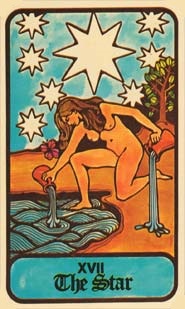
  • Empty your cup to fill your cup. This month’s symbol is the Chalice, which is often associated with the Holy Grail. In Arthurian legend, Sir Galahad is warned that he may lose himself by taking up the quest.  He replies, “If I lose myself I save myself!”  The chalice symbol embodies the universal medicine of self-sacrifice and the relinquishing of ego. The more we exalt ourselves the farther the grail cup recedes; the more we humble ourselves the faster it returns to us. If we lose ourselves like Galahad then perhaps there is hope that we can save ourselves.   This is why we must relinquish our own wants and needs before we can accept the communion wine (“Thy will be done, on earth as it is in heaven”).  This operation is depicted on the XVIIth key, The Star.  Meditate on this pouring out and pouring in.  Last week I suggested that you can’t say “Yes” with all your heart without first learning how to to say “No.”  This week I’m telling you that you have to be empty before you can be full.
  • If it ain’t in the training journal it didn’t happen.  Do the work, the external and internal, and write about what you did and thought in your journal.  Introspection, self-examination and measurement are the key to progress.


TWO MARTIAL ARTS DISTANCE LEARNING PROGRAMS AVAILABLE. 100% free and operated through my non-profit, Cabal Fang is martial arts for personal development, self-defense and fitness. Bobcat Frontier Martial Arts is just $19.99/month and that’s your choice if you’re interested in Frontier Rough ‘n’ Tumble — the fighting arts, survival skills, lifeways and ethos of the colonial and indigenous peoples of North American during the frontier period (1607 – 1912). What are you waiting for — enroll today!

Science and Christianity Hand in Hand

A humble Friar named Roger Bacon pioneered the scientific method, a Belgian priest named Father George Lemaître was the originator of the Big Bang Theory, and Father Gregor Mendel was the world’s first geneticist.

Religions are not superstitions — they are social technologies

About 40,000 years ago there were only about 2,000 breeding Homo Sapiens left.  Humanity was on the verge of annihilation.  In order to survive, humans starting perfecting ritual systems to ensure cooperation, prevent infighting, and thwart extinction.  These ritual systems evolved into religions.   For more on this topic start by reading Supernatural Selection by Matt Rossano.

The religion that changed the the world most dramatically —  in ways that have never been equaled — is Christianity.  Christianity invented some of the most incredible social technologies ever devised, such as organized charity,  women’s rights, orphanages, universal human rights, higher education, libraries, and more.  Read Dominion by Tom Holland for more details.

Christianity is not at odds with science

BioLogos was founded by one of the top biologists in the world, Francis Collins. He led the Human Genome Project and now directs the National Institutes of Health. In 2006, he wrote the best-selling book The Language of God in which he tells the story of his journey from atheism to Christian belief, showing that science is not in conflict with the Bible, but actually enhances faith.

For more info on this topic

Read my post Mythbusting Anti-Christianity or watch my Christianity for Doubters video series:


Book Review: “Talks to Teachers on Psychology” by William James

An esteemed and pragmatic colleague sent me a copy of William JamesTalks to Teachers on Psychology.  As you can see by the grainy picture on the right, this First Rate Publishers edition is strangely and inexplicably titled incorrectly as Talks to Teachers on Philosophy which isn’t  at all ‘first rate.’  But it is for two entirely different reasons that I recommend those wishing to read this book purchase another edition, those being (a) it lacks page numbers and (b) the type is extremely small.

Upon receiving the book I was perplexed.  Why would my associate want me to read this 100+ year-old psychology book?  Was there some nudge-nudge-wink message here?  This and other questions assailed me.  But the gift-giver being the sort of fellow who shoots straight both literally and figuratively, I quickly saw that this was simply a sincere gift of something he deemed valuable and important.  So I rolled up my sleeves and dug in. 

The volume is thin.  Expecting not much to chew on, I figured I’d read it across one or two nights and send a quick note of thank you.  But but O, happy surprise!  I reached into the sack for a puppy and found a python.  It is a thin book — true enough — but thin, not like boarding house soup, but thin like a fang.  It bites to bone and holds fast.

This little bugger took me two weeks to dissect.  As you can see by the photo above, I put ten tabs in the book to mark key points to return to later.  There’s no magic to that number, it just worked out that way.  Here they are in brief:

  1. Focus on gaining the student’s attention.  Make a lasting impression that is lifelong.  Above all, create a “devouring curiosity” in the student.
  2. Engage student’s senses with material objects, or at least with stories of action, rather than with abstract ideas.  Be excellent and imitable.  Pull students forward by inspiring students to emulate you.  Pushing doesn’t work.
  3. When students “back” (like a horse before a hurdle) or get stuck (either outwardly with attitude or inwardly with self-frustration) move on.   Let them forget the sticky spot.  Then make a circuitous approach later using a slightly different approach so that they don’t recognize the spot.  Often they’ll leap right over without incident.
  4. Help them build good habits.  Habits are far more powerful than most people believe.
  5. Make substitutions for negative ideas, perspectives and thoughts.  Phrase things as “dos” not “don’ts.” Accentuate the positive (see #2 above).
  6. Feelings and actions are behaviorally linked.  To some extent we are afraid because we flee and sad because we cry.  To modify behavior, act how you wish to feel.  “Action seems to follow feeling,” James says, “but really action and feeling go together; and by regulating the action, which is under the more direct control of the will, we can indirectly regulate the feeling, which is not.”  Brilliant.
  7. Relaxation reduces wasted energy and prevents moods, nervous breakdowns, melancholy and more.  Harmony, dignity, ease and calm are the key to excellence and happiness.  This speaks directly to revelations I’ve had recently through the Going Powhatan project.
  8. In a related vein, there is a lengthy quotation from a book called The Practice of the Presence of God, the Best Ruler of a Holy Life by Brother Lawrence that also relates to the idea of grace as both a physical and mental state.
  9. Another lengthy quote attributed to one Josiah Royce from his book The Religious Aspect of Philosophy.  Brilliant.
  10. A long section at virtually the end of the book about the tendency of people to polarize that was incredibly insightful and completely relevant to the political environment in the U.S. in the world today.  It could’ve been written this week.  This bit is scintillating as a star ruby.

I’m not ashamed to admit that James was a big hole in my knowledge of philosophy, and happy to report that it is far from plugged but at least somewhat patched.  I have added The Varieties of Religious Experience to my reading queue as well.

A truly estimable book.  Highly recommended, especially to educators, parents, pastors, managers and leaders of all stripes.


If you liked this post…

There’s a good chance you’d love my e-book The Wildwood Workbook: Nature Appreciation and SurvivalClick here to download it in any format.  35 exercises guaranteed to deepen your relationship with nature and get your heart and mind engaged like never before.  120 pages.

Want to study Frontier Rough ‘n’ Tumble martial arts?  Click here to enroll in the Bobcat Frontier Martial Arts distance learning program for just $19,99/month — all learning materials, testing and certificates included (and a free hat and t-shirt when you sign up too).