
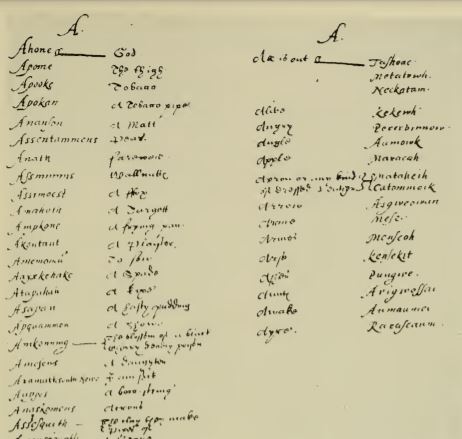
Some of Strachey’s Powhatan words in his actual hand
According to the National Museum of the American Indian, over 500 native languages were spoken in North America prior to European contact. Of those 500 languages, the Catalog of Endangered Languages reports that only 150 are still spoken today. There were thousands of tribes as well, of which only about 600 remain.
The number of tribes the diversity of languages bears out what we find in historical accounts and archaeological finds, which is that
the native tribes of North America were insular, territorial and, for want of a better word, grumpy. Ritual violence, intertribal warfare, conflict, dispute and bloodshed were a part of daily life. In addition to their words, they did a fair amount of their talking with weaponry.
 Just because they didn’t shy away from a fight doesn’t mean their languages weren’t rich, beautiful and complex. I know this because, as part of this project, I decided I should learn how to speak Powhatan. But I soon found out that Powhatan was one of first indigenous languages to go extinct. Powhatan, or Virginia Algonquian, hasn’t been spoken since the 1790s. Fortunately though, Willam Strachey, an English writer who made it to to Virginia after being stranded in Bermuda by the shipwreck of the Sea Venture, wrote extensively on the language and culture of the Virginia’s natives.¹ We have his word lists, as well as John Smith’s. And thanks to linguists like Frank Siebert and Blair Rudes, who have poured over the work of Stachey and Smith and put together partial reconstructions, we have at least the skeleton of Virginia Algonquian.
As soon as you jump in four things jump right back at you. First, Powhatan has provided American English with more loan words than any other indigenous tongue. Raccoon, opossum, tomahawk, hominy, terrapin, hickory, chum, moccasin and persimmon all come from Powhatan, and that’s just the short list.²
Second, it’s an agglutinating language. Word order isn’t all that important because you just keep adding prefixes, suffixes and circumfixes onto the root word until you get the meaning you want. A properly conjugated verb is a sentence unto itself.
Third, it’s an action language. Verbs are conjugated based on whether they are transitive or intransitive and nouns are declined based on if they are proximate (nearby) or obviative (over there). This is a language designed to tell you what’s moving, what’s not moving, and who’s doing what to who.
And fourth, it’s hard to learn. The two biggest snares are that it has very little in common with English and there’s nobody to practice conversation with. But hopefully that conversation problem will dissipate. There are people trying to bring the language back. The Patawomeck tribe up in Stafford, Virginia are teaching language classes using the materials Blair Rudes prepared for the movie The New World, and the Eastern Woodlands Revitalization Project is also spearheading an effort.³
For the time being though, I’m on my own.
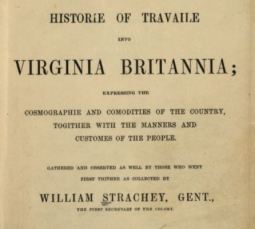
¹ Strachey, William. 1610-1612. The Historie of Travaile Into Virginia Britannia Ed. Richard Henry Major. London: Hakluyt Society, 1849.
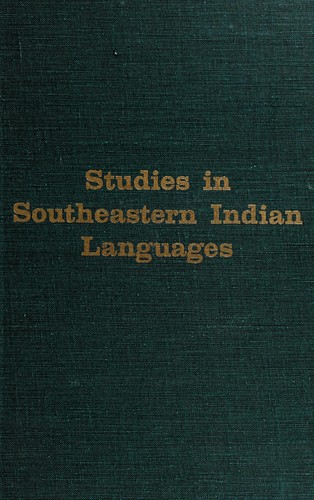
² Siebert, Frank. 1975. “Resurrecting Virginia Algonquian from the dead: The reconstituted and historical phonology of Powhatan,” Studies in Southeastern Indian Languages. Ed. James Crawford. Athens: University of Georgia Press, pp. 285–453.
³ Rudes, Blair. 2006. “Giving Voice to Powhatan’s People: The Creation of Virginia Algonquian Dialog for ‘The New World’” Paper written for Coastal Carolina Indian Center.
Next Time: Bathing Cold
 If you liked this post…
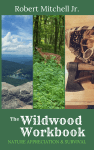
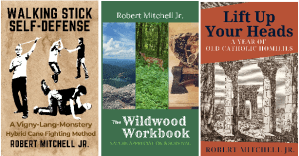
There’s a good chance you’d love my e-book The Wildwood Workbook: Nature Appreciation and Survival. Click here to download it in any format. 35 exercises guaranteed to deepen your relationship with nature and get your heart and mind engaged like never before. 120 pages.
 Want to study Frontier Rough ‘n’ Tumble martial arts? Click here to enroll in the Bobcat Frontier Martial Arts distance learning program for just $19,99/month — all learning materials, testing and certificates included (and a free hat and t-shirt when you sign up too).




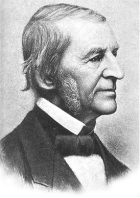 I find the Englishman to be him of all men who stands firmest in his shoes. They have in themselves what they value in their horses, mettle and bottom. On the day of my arrival at Liverpool, a gentleman, in describing to me the Lord Lieutenant of Ireland, happened to say, “Lord Clarendon has pluck like a cock, and will fight till he dies.” ~
 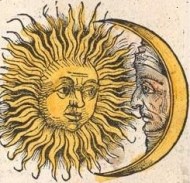 Reality check. This is the final post on October’s spiritual symbol, the Luminaries — the Sun and Moon — which symbolize (among many other things) the relationship between reality (the Sun) and imagination (the Moon). This can be the map vs. the actual terrain, your self-conception vs. the real you, and so forth. Imagination is a great tool. It allows us to try things out in our heads without having to actually do them, which has had tremendous evolutionary benefits. What if we had to a jump in order to see whether or not a fall was deadly? The drawback is that we can mistake the imaginary for the real. How much of what we tell ourselves we’re capable of can we really do? Find an assumption about yourself that you can test safely and do so. Don’t assume you can get there. Actually get there!

 Robert Mitchell Jr.